
The difference between AI change and AI transformation
<p><br> <span class="small">June 18, 2026</span></p>
<p><b>Too many leaders focus on quick wins and task automation. Our study of two banks highlights the advantages of a strategic, multi-track implementation.</b></p>
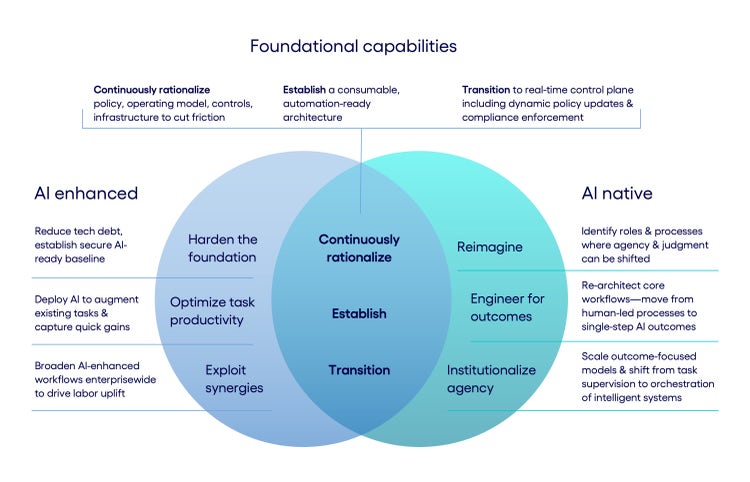
<p>There is a particular kind of error that institutions make in moments like this, the moments when a new technology arrives not as an improvement, but as a force.</p> <p>Artificial intelligence is such a force. It does not simply make things faster. It changes what is possible. And yet, faced with that possibility, most organizations reach for the nearest lever. They look for productivity.</p> <p>It’s an understandable instinct. It’s also, more often than not, the wrong place to begin. Because what begins as a search for productivity often ends somewhere else entirely: higher structural cost, greater operational complexity and a steady erosion of optionality (i.e., the ability to do something in a different way tomorrow than you do it today).</p> <h3><span class="h4">When speed increases cost</span></h3> <p>Across industries, financial services most clearly, what we are seeing is a rush to deploy AI at the task level. Draft this. Summarize that. Automate the next step in a familiar workflow.</p> <p>These efforts produce quick wins. They demonstrate value. They create momentum. But they also create something else: a constellation of disconnected solutions. Tools that don’t speak to one another. Models trained on inconsistent definitions of customers, products and risk. Automations layered onto processes that were never designed to interoperate.</p> <p>HFS Research reports that 43% of organizations <a rel="noopener noreferrer" target="_blank" href="https://www.hfsresearch.com/research/unqork-ai-drowns-tech-debt/">are already seeing AI generate</a> new forms of technical debt. Gartner found that by the end of 2025, at least 50% of generative AI projects <a rel="noopener noreferrer" target="_blank" href="https://www.gartner.com/en/articles/genai-project-failure">had been abandoned</a> after proof of concept. McKinsey finds that while <a rel="noopener noreferrer" target="_blank" href="https://www.mckinsey.com/capabilities/quantumblack/our-insights/the-state-of-ai">88% of firms are using AI</a> in at least one business function, fewer than 40% report any meaningful bottom-line impact.</p> <p>The consequences tend to show up in the same three places. First, cost duplication: parallel data pipelines, model stacks and infrastructure accumulate before anyone notices, often producing double-digit percentage overlap in spend before consolidation begins. Second, there is the issue of control fragmentation. As models proliferate, governance and audit costs rise non-linearly. This situation is a particular liability in regulated environments where explainability is not optional. Third, time-to-value degradation: Instead of accelerating delivery, fragmentation forces rework, turning what should be weeks of extension into months of integration.</p> <p>What was intended to improve operating leverage begins, instead, to erode it. This is not a failure of ambition. It is a failure of sequencing.</p> <h3><span class="h4">A tale of two banks</span></h3> <p>Consider a large regional bank that moved quickly and decisively. Within 18 months, it had deployed more than a dozen copilots across retail, lending and operations. Multiple document intelligence models for underwriting and servicing. Independent automation layers embedded in existing workflows. </p> <p>Each initiative delivered localized gains. Each was built independently. There was no shared understanding of customers or products across the organization. Three separate definitions of "customer" existed across onboarding, fraud and servicing. Models produced conflicting outputs in credit and financial crime, forcing manual reconciliation. </p> <p>Technology teams were drawn into repeated debates over which system was authoritative. Unfortunately, definitive resolution was difficult, if not impossible, because no common foundation existed for making the required decisions.</p> <p>The consequences compounded. Infrastructure and model costs grew faster than anticipated. Compliance teams struggled to maintain consistent audit trails across systems. New use cases required six to nine months of rework. Business units began to lose confidence in outputs that varied depending on which system was queried.</p> <p>The bank had invested in AI but had failed to build a system that could govern it and a model that could enable its people to shift to this new working model.</p> <p>Now consider a different institution—a global bank that chose a more deliberate path and paid a real price for that deliberateness.</p> <p>Before committing to enterprise-wide deployment, its technology and business leaders spent months in difficult conversation about a deceptively simple question: what would it mean to build AI into the enterprise, rather than onto it? There were delayed initiatives. There were frustrated executives. There were competitors, visible on the horizon, moving faster.</p> <p>This bank identified a set of capabilities it believed would be load-bearing: a unified semantic model giving the entire organization a shared language for customers, products and risk; a modular orchestration layer capable of coordinating intelligent agents across business lines; an infrastructure capable of serving both analytical and operational needs in real time; and a governance framework embedded from the outset rather than retrofitted after the fact. These were not aspirational documents. They became the control plane of the enterprise the layer that determines not just how systems interact, but how decisions are made.</p> <p>This is where advantage accumulates. Once these layers are established, new use cases extend existing capabilities rather than duplicating them. Governance is applied consistently rather than retrofitted. Innovation compounds rather than fragments.</p> <h3><span class="h4">Two speeds, one system</span></h3> <p>But the bank did not wait for the foundation to be finished before it began learning.</p> <p>Alongside the foundational work, it ran a deliberately contained set of tactical deployments—experiments designed to build organizational fluency while the deeper architecture took shape. AI-assisted case investigation in compliance. A copilot in a single contact center. Document processing in a narrow trade operations segment.</p> <p>Each effort was bounded by design. New use cases required approval against a genuine test: does this contribute to the foundation, or does it stand apart from it? Several proposals that would have produced fast results were deferred because they would have created the same fragmentation the bank had set out to avoid. The technology team held the line, even when business units pushed.</p> <p>What this discipline produced was something most AI programs miss: a two-speed investment model that actually functioned as a single system. The near-term track, call it “AI-enhanced” (see figure below), focused on improving existing processes. Copilots for frontline productivity. Automation of document-heavy workflows. AI-assisted compliance and operations. These generated measurable efficiency gains, but they were governed by a constraint: every initiative had to produce reusable components—data structures, semantic definitions, orchestration patterns—that contributed to the broader architecture.</p> <p>The longer-horizon track, which can be called “AI-native,” focused on redesigning processes from first principles. Agent-driven workflows built around outcomes rather than tasks. Dynamic orchestration across functions. Operating models designed for real-time decisioning. Its objective was not to accelerate existing processes but to replace them with something a conventional organization could not operate.</p> <p>The critical difference was not the existence of two tracks; most organizations have a near-term roadmap and a long-term vision. The difference was the relationship between them. The enhanced track funded learning; the native track defined direction; both were required to build the same system.</p> <p>The controlled experiments served a purpose beyond scale. Teams learned how to evaluate models, how to manage drift and how to embed governance into execution. Leaders developed intuition for where AI created genuine value and where it produced only the appearance of it. By the time the foundational architecture was sufficiently mature, the organization was applying real institutional knowledge to real infrastructure.</p>
#
<p><span class="small">Figure 1: Two-Speed AI Investment Model. Source: Cognizant, 2025.</span></p> <h3><span class="h4">Reinventing the enterprise</span></h3> <p>Only then was the bank able to start scaling the use of AI across the organization. And when it did, it did not automate existing processes. It redefined them.</p> <p>The onboarding process, the long sequence of steps to be executed rather than an outcome to be achieved, was rebuilt not by accelerating what existed, but by asking what a fully intelligent process would look like from the customer's point of view. The answer was an agent-driven system capable of orchestrating data collection, identity verification, risk assessment and account activation in near real time, with human review reserved for exceptions that genuinely required it.</p> <p>The result was a different kind of process that achieved improvements that could not have been realized by automating the old one.</p> <p>The two tracks eventually converged. Capabilities built for near-term gains were reused in longer-horizon reinventions. Lessons from the reinventions improved the foundation. What had begun as two speeds became, in time, one coherent system that is governable, compounding and capable of receiving whatever comes next.</p> <h3><span class="h4">What leaders must do now</span></h3> <p>The path forward requires three decisions made early and held firmly. </p> <ol> <li><b>Define the foundation</b>. Identify the semantic, orchestration, data and governance capabilities that every AI initiative must build toward and make that architecture explicit before the portfolio grows too large to govern.<br> <br> </li> <li><b>Enforce architectural intent</b>. Be explicit about which high-value opportunities will be deferred because they create fragmentation. This requires organizational courage; the proposals that get deferred are usually the ones with the most visible near-term returns.<br> <br> </li> <li><b>Run two speeds as one system</b>. Ensure near-term investments generate reusable capabilities, while long-term efforts redefine the operating model. The discipline that connects them is what separates compounding investment from accumulating debt. This will also enable a lens on continually learning to be embedded into how your organization operates to create sustained momentum and change.</li> </ol> <p>As Bain <a rel="noopener noreferrer" target="_blank" href="https://www.bain.com/insights/why-ai-stumbles-without-a-solid-data-strategy">has noted</a>, successful AI transformations are built on deliberate investment in data, governance and operating model from the outset. The institutions that will lead are not those that move fastest in the early stages. They are those that build the architecture that allows speed to compound safely.</p> <h3><span class="h4">The real measure</span></h3> <p>The difference between the two institutions was not ambition. It was not urgency. It was not even talent or investment. It was intent.</p> <p>One treated AI as a collection of tools to deploy. The other treated it as a system to build. That distinction carries consequences. It determines whether investment compounds or fragments, whether costs decline or escalate, whether optionality expands or contracts.</p> <p>Move quickly without structure, and complexity accumulates quietly until it becomes constraint. Move with structure and intent, and something else becomes possible—not simply a more efficient enterprise, but a more adaptive one. One where each investment increases the range of what the organization can do next.</p> <p>AI arrived as a force. The question is whether it leaves your organization more capable—or merely more complicated. That is the difference between change and transformation.</p>

<p>Ed is a Vice President in the Banking and Capital Markets Group. He is responsible for advising CIO and CTOs on execution strategies for technology-driven operational improvement, transformation and innovation initiatives. He participates both as a Consultant and a Delivery Leader.</p>