
Agentic AI in real-time marketing: Empowering, not replacing, CMOs
<p><br> <span class="small">November 14, 2025</span></p>
Agentic AI in real-time marketing: Empowering, not replacing, CMOs
<p><b>CMOs need to understand where agentic AI fits into real-time interaction management—and precisely where humans are an essential part of the marketing process.</b></p>
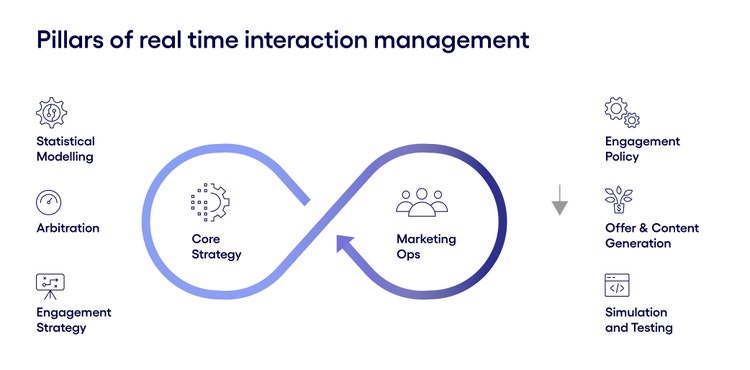
<p>When it comes to real-time marketing, the appeal of agentic AI is clear. With its ability to deliver faster campaign cycles, a personalized customer experience and creativity at scale, agentic AI can transform how marketing offers are designed, tested and executed. We’ve heard of leading brands using agentic AI to increase revenue by 25% and reduce costs per acquisition by 40%. </p> <p>However, agentic AI cannot do this alone. It’s essential for chief marketing officers (CMO) to understand not only where agentic AI fits into real-time interaction management—and where it doesn’t—but also precisely where humans are an essential part of the marketing process. </p> <p>CMOs also need to take a blended approach, combining multiple forms of AI to cost-effectively deliver hyper-personalized, real-time engagement without sacrificing trust or compliance. </p> <h5>Where agentic AI fits into real-time interaction management</h5> <p>Let’s start by looking at the two core layers of real-time interaction management (RTIM) platforms: the strategy layer and the operations layer. Each plays a distinct role in shaping customer engagement, and each carries different expectations around control, transparency and speed.</p>
#
<h5><br> The strategy design layer: caution required</h5> <p>This is the decisioning intelligence layer, which governs the logic behind every customer interaction. For example, strategy design might determine which product to offer based on a customer’s recent behavior, purchase history and lifetime value. </p> <p>It includes:</p> <ul> <li><b>Data strategy</b>: Collecting and integrating actionable data.</li> <li><b>Signal detection</b>: Interpreting real-time behaviors across touchpoints.</li> <li><b>Modeling</b>: Predicting customer needs and preferences.</li> <li><b>Decision arbitration</b>: Balancing customer expectations with business goals using business rules and AI.</li> </ul> <p>Strategic decisions often involve pricing and eligibility considerations—areas where errors carry financial, legal and reputational consequences. This is why embedding agentic AI directly into the core decision logic of marketing platforms introduces serious risk, especially in highly regulated sectors like banking, insurance and healthcare. </p> <p>The risks emanate from three key areas. One is that LLMs can be black boxes, making decision processes opaque and hard to audit. In some cases, they are non-deterministic, meaning the same input can produce different outputs.</p> <p>A second risk area is compliance. Regulations require explainability and traceability that LLMs can’t always deliver on. A third is the potential for costly errors, as LLMs can hallucinate or generate incorrect outputs, risking mispriced offers, reputational damage or regulatory breaches. Imagine an AI-driven decision engine in a bank that approved credit offers based on flawed logic—it could lead to millions in losses and penalties.</p> <p>For all these reasons, this layer demands a higher level of AI precision, control, transparency and traceability, especially in regulated industries. Agentic AI should be used cautiously here, with human-in-the-loop (HITL) oversight to ensure ethical, compliant and defensible decisions.</p> <h5>The marketing operations layer: a good fit for agentic AI</h5> <p>This is the execution layer, which delivers on the strategy. For instance, marketing operations decides how that product offer is delivered—via email, push notification or in-app message, and with what creative tone or format. </p> <p>It includes:</p> <ul> <li><b>Offer and content creation</b>: Designing personalized messages and assets.</li> <li><b>Eligibility and filtering</b>: Deciding who receives which message and when.</li> <li><b>Simulation and testing</b>: Running experiments to optimize performance.</li> </ul> <p>These tasks are manual and time-consuming. Here, generative and agentic AI excel, as they can accelerate execution, optimize campaigns, reduce overhead and inspire creativity, provided there are clear boundaries and oversight.</p> <h4>A closeup view of agentic AI in marketing operations</h4> <p>Agentic AI can transform marketing operations through: </p> <ul> <li>Automated content generation: Rapidly producing campaign assets for diverse personas and channels.</li> <li>Simulation at scale: Running adaptive tests to optimize outcomes.</li> <li>Operational agility: Reducing campaign cycle times from weeks to days.</li> <li>Cost efficiency: In our work with clients, we’ve seen cost efficiency gains of up to 40%.</li> </ul> <h5>A modular multi-agent framework</h5>
#
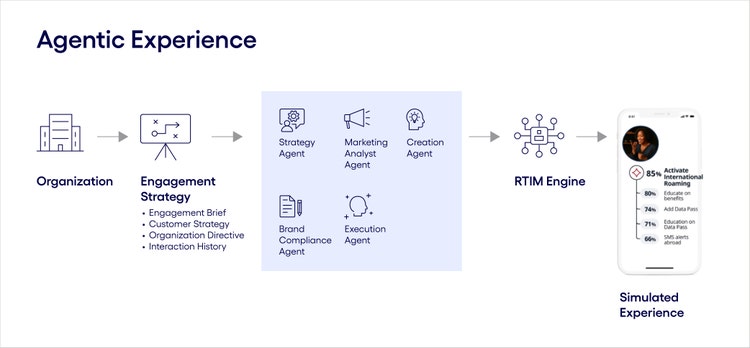
<p><br> Agentic AI accomplishes this through networks of specialized agents, each designed for a distinct function. Each agent hands off its outputs to the next, creating a seamless, governed workflow from strategy to execution. </p> <p>Governance is built in, with brand compliance agents and human-in-the-loop (HITL) checkpoints ensuring accountability . This modular approach delivers agility, scalability and resilience in fast-paced marketing environments.</p> <ul> <li><b>Ideation agent</b>: Turns engagement data into actionable recommendations for offers, content and journeys.<br> <br> <ul> <li><b>Inputs</b>: Engagement brief, customer journey, interaction history, behavior data.</li> <li><b>Outputs</b>: Offer and content recommendations, journey paths, context determination, predictor updates (refining targeting models based on new data).<br> </li> </ul> </li> <li><b>Marketing analyst agent</b>: Validates and prioritizes strategies, identifies emerging personas and sets simulation plans.<br> <br> <ul> <li><b>Inputs</b>: Strategy agent recommendations.</li> <li><b>Outputs</b>: Prioritized artifacts, test personas, simulation strategies.<br> </li> </ul> </li> <li><b>Creation agent</b>: Generates personalized content and offers across channels in minutes, not weeks.<br> <br> <ul> <li><b>Inputs</b>: Recommendations and priorities from the marketing analyst agent.</li> <li><b>Outputs</b>: Offers, messages, text variants, engagement rules and model updates.<br> </li> </ul> </li> <li><b>Brand compliance agent</b>: Ensures every asset meets brand, legal and ethical standards before execution.<br> <br> <ul> <li><b>Inputs</b>: Content from the creation agent.</li> <li><b>Outputs</b>: Tone and image recommendations, arbitration checks, bias and regulation compliance.<br> </li> </ul> </li> <li><b>Execution agent</b>: Deploys offers in real time, optimizing next-best actions across personas.<br> <br> <ul> <li><b>Inputs</b>: All validated artifacts from previous agents.</li> <li><b>Outputs</b>: Execution in RTIM engine for dynamic personalization.</li> </ul> </li> </ul> <h4>Human-in-the-loop as a strategic imperative</h4> <p>The bottom line is, CMOs shouldn’t avoid agentic AI. They just need to govern it effectively. In addition to using agentic AI for execution and optimization rather than autonomous strategic decisioning, they need to ensure that every strategic recommendation is passed to a human for review. </p> <p>Some may argue, “Can’t we just train the AI better?” or “Won’t HITL slow us down?” But while better training reduces risk, the lack of explainability in LLMs still makes human oversight essential—especially where compliance and trust are at stake.</p> <p> An example is a top North American insurance company, which we worked with to automate outreach and content generation while keeping policy and risk decisions under transparent, auditable models with human oversight.</p> <p>HITL is essential for trust, accountability and sustainable growth. With HITL, businesses can ensure they:</p> <ul> <li><b>Balance customer centricity with business context</b>. AI can rapidly personalize and segment, but strategic priorities—ROI, brand reputation and compliance—must remain under human stewardship. HITL empowers leaders to weigh trade-offs, evaluate scenarios and plan long-term strategies.<br> <br> </li> <li><b>Apply domain expertise and intuition</b>: Human experts bring industry knowledge, intuition and ethical sensibilities that AI cannot replicate, especially in complex, ambiguous or high-stakes situations.<br> <br> </li> <li><b>Perform ethical and bias checks</b>: Human oversight is essential for identifying and mitigating bias, conducting fairness audits and promoting inclusive outcomes.<br> <br> </li> <li><b>Handle exceptions and edge cases</b>: AI may falter with novel or rare scenarios. For example, a telecom provider’s AI-driven campaign once misclassified high-value customers as churn risks, but HITL intervention prevented costly retention offers.<br> <br> </li> <li><b>Achieve cross-functional integration</b>: Strategic decisions often require input from marketing, compliance and finance. HITL fosters collaborative, cross-disciplinary evaluation.<br> <br> </li> <li><b>Enable model validation and continuous improvement</b>: Humans monitor drift, validate models and ensure ongoing relevance through feedback loops. For instance, a leading insurer uses HITL to review AI-driven risk models quarterly, avoiding regulatory breaches.</li> </ul> <p>In the end, HITL is not just a safeguard—it’s a strategic necessity that ensures AI augments rather than replaces sound business judgment.</p> <h4>The blended model approach to real-time marketing</h4> <p>In addition to HITL, agentic AI initiatives need to combine human oversight with AI’s creative and operational strengths. While many leaders are eager to fully automate real-time interaction management with generative and agentic AI, the reality is more nuanced. </p> <p>A hybrid approach optimizes the strengths of three types of AI:</p> <ul> <li><b>Traditional AI</b>: Offers transparency, traceability and compliance—critical for regulated industries and auditability.<br> <br> </li> <li><b>Generative AI</b>: Excels at interpreting nuanced signals like tone of voice, sentiment, and behavioral patterns. For example, in a live chat, generative AI can detect frustration in a customer’s tone and suggest an empathetic response, while the core decision logic remains governed by interpretable models.<br> <br> </li> <li><b>Agentic AI</b>: Orchestrates a network of specialized agents that collaborate across strategy, creation, compliance and execution. In RTIM, agentic AI not only orchestrates execution and interprets signals; it also manages workflows, enforces brand and regulatory standards, and coordinates human-in-the-loop oversight.</li> </ul> <h4>The agentic AI path to success</h4> <p>To achieve both speed and safety, organizations must adopt a disciplined, hybrid approach. They can do this by:</p> <ul> <li><b>Defining clear boundarie</b>s: Use agentic AI for ideation and operational agility.</li> <li><b>Maintaining governance</b>: Keep core decision logic under traditional AI and HITL oversight.</li> <li><b>Applying explainability</b>: Reserve high-stakes decisions for interpretable models and human experts.</li> </ul> <p>By doing so, CMOs can drive innovation with integrity, delivering intelligent, context-aware and customer-centric experiences at scale.</p> <p><i>To learn more, how leading RTIM platforms like Pega CDH can help your organization to achieve their marketing vision, visit the </i><a href="https://www.cognizant.com/us/en/services/enterprise-application-services/pega-platform-services" title="https://www.cognizant.com/us/en/services/enterprise-application-services/pega-platform-services" target="_blank" rel="noopener noreferrer"><i>Pega Software Services</i></a><i> section of our website or </i><a href="https://www.cognizant.com/us/en/services/enterprise-platform-services/pega-platform-services#spy-contact-us" target="_blank" rel="noopener noreferrer"><i>contact us</i></a><i> for a Demo.</i></p>

<p>Victor is a seasoned Business Architect with 20 years of experience, specializing in designing and implementing Customer Journey, Marketing Automation, NBA Decisioning, BPM & CRM solutions and Product Development. Victor has Architected Business & Decisioning capabilities as trusted advisor to Business and IT leaders of some of the largest multi-national corporations.</p>