
How to leverage agentic AI for business service resilience
<p><br>
<span class="small">October 08, 2026</span></p>
<h2><b><span class="h6">With agentic AI, businesses can get a shared view of service vulnerabilities and a basis for making informed decisions about risk management.</span></b></h2>
<p>Maximizing service resilience is a top priority for cable, satellite and technology companies. Every dollar invested in telecom infrastructure <a rel="noopener noreferrer" target="_blank" href="https://www.worldbank.org/en/topic/digital/publication/resilient-telecommunications-infrastructure">returns four times that much</a> in savings, according to the World Bank Group.</p>
<p>And the costs of getting service resilience wrong can be steep. According to a study by Splunk<sup>1</sup>, 81% of technology leaders say they’ve lost customers due to downtime, and 47% admit customers are often the first to detect service degradation or outages.</p>
<p>Typically, however, investments occur independently, with functions like app upgrades and modernization, batch processing, data center, network operations and operating system upgrades formulating their own individual paths to ensure service resilience.</p>
<p>The problem with this piecemeal approach is that strengthening one technology area can shift bottlenecks elsewhere in the service chain, creating a corporate whack-a-mole. A data center upgrade may strengthen operations, but if other elements of the service chain remain unprotected, only the data center—not the service itself—becomes more resilient.</p>
<p>Such downstream shifts often go unseen until a disruption occurs, resulting in more hours of downtime. I’ve seen companies spend six to nine hours of a 16-hour outage trying to troubleshoot what’s gone wrong. In the age of social media, where a single outage can blow up online and inflict reputational damage, companies need an approach that’s comprehensive and proactive.</p>
<h3><span style="font-weight: normal;" class="h4">An agentic approach to service resilience</span></h3>
<p>That’s where viewing service resilience as a business strategy comes in. With this approach, businesses examine each service and map out what’s required to deliver it. The service map provides the business and IT with a shared view of service vulnerabilities and a basis for making informed decisions about risk management.</p>
<p>It’s a proactive approach but also labor-intensive. An agentic AI-based solution makes a resilience strategy practical because it relies on agents for much of the effort involved with building out the service map and keeping it current.</p>
<h3><span style="font-weight: normal;" class="h4">What strategic service resilience looks like</span></h3>
<p>An end-to-end service resilience strategy doesn't eliminate every risk. However, it does give the business enough information to decide which risks are worth mitigating and which it's willing to accept.</p>
<p>The first step is establishing the level of resilience the business is willing to commit to. For example, a company might commit to restoring service within 12 minutes, or require the network to be designed such that no single outage can affect more than a defined number of customers.</p>
<p>Next is creation of a service map to understand what’s required to meet that commitment. The model provides the 360-degree view the company needs to see how the elements of the service connect, including components, applications, hardware, manual processes and vendor and knowledge base dependencies.</p>
<p>For example, a cable company might commit to maintaining 99.95% availability for its broadband service, ensuring no single point of failure can disrupt service across an entire market. It would then tackle two key questions: What would it take for our broadband service to meet this resilience level, and where in the chain do we fall short?</p>
<p>The answers might reveal that a critical service component has an underpinning app with an active:passive architecture environment instead of active:active, or that service delivery depends on a third party that can't restore operations quickly enough to meet the recovery target.</p>
<h3><span style="font-weight: normal;" class="h4">Why the resilient service model is a gamechanger</span></h3>
<p>The mapping process is often eye-opening for enterprises. For one thing, it provides IT and business leaders with a common basis for evaluating the resilience investment and choosing how much risk they're willing to retain. For another, the shared information alters the conversation between IT and business. It reframes service shortfalls as a business conversation about the level of risk the company chooses to carry.</p>
<p>This point is critical because companies’ risk appetite often changes over time as business models, customer expectations and the importance of individual services evolve. That can leave companies with an IT architecture designed for an earlier set of assumptions and misaligned with the resilience level the business expects.</p>
<p>Service model mapping becomes a key tool. Instead of the business questioning the high cost of IT’s budget request for an infrastructure upgrade, both sides now have a clear view of service vulnerabilities and the consequences of not addressing them.</p>
<p>For example, meeting a newly defined standard might require a multimillion-dollar investment in improvements. The decision then becomes whether the company is willing to include it as a non-discretionary expenditure to achieve the level of resilience it has committed to. If it’s not—and that's a legitimate business decision—then it will need to acknowledge the risk it’s accepting.</p>
<h3><span style="font-weight: normal;" class="h4">How agentic AI makes a holistic view of service resilience more practical</span></h3>
<p>Given the benefits of a service resilience initiative, why don’t more companies have one? The answer is that building out the strategy and underpinning framework—but more importantly, keeping it current—has traditionally been labor-intensive and hence costly. The volume of data sources that need to be compiled and updated regularly can be daunting, ranging from service catalogs and inventory to configurations of underlying components.</p>
<p>Agentic AI changes the economics of maintaining an end-to-end view by mitigating the labor involved. We could deploy an agentic solution that cuts the time to create the resilience framework from months to weeks. This would involve identifying “platinum” services that impact the moment of truth for the end customer; mapping the service chain for all its components across the process, apps, infrastructure, people, controls and vendors; and then assessing its resilience against the defined risk appetite derived for service quality attributes promised to the customer.</p>
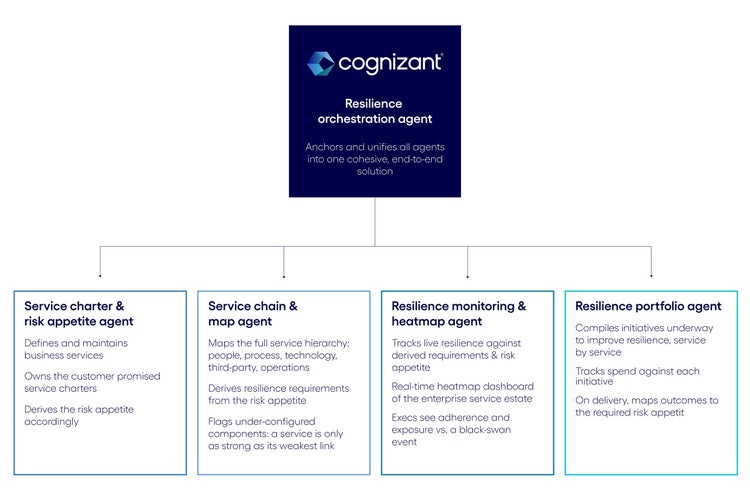
<p>Unified by a central orchestrator, the typical framework could consist of four agents that feed data to a real-time resilience dashboard. Leaders could gain visibility into real-time service status to demonstrate to regulators and Wall Street their proactivity in managing their estate and avoiding unintended customer impact.</p>
#
<p><br>
Once developed, tested and deployed for the first time, the agentic AI system could enable us to map as much as 80% of a service chain in days (with humans in the loop) rather than weeks and months.</p>
<p>Just as important, companies don’t have to boil the ocean. Instead of taking a big-bang approach, they can build the service model and agentic framework as a series of small projects and integrate with other initiatives underway rather than overhauling the entire service catalog all at once.</p>
<p>A service resilience strategy gives leaders a clear line of sight they haven’t traditionally had, from the service they promise customers to the investment and risks behind it. With agentic AI making that view practical to build and maintain, companies can make resilience a business decision—and differentiate themselves with service availability, performance and reach they can back up.</p>
<p><b><span class="small">References</span></b></p>
<p><i><span class="small">1. https://newsroom.cisco.com/c/r/newsroom/en/us/a/y2026/m05/the-600-billion-wake-up-call-new-splunk-research-reveals-downtime-is-a-systemic-business-crisis.html</span></i></p>

Kandarp has vast experience in the solutioning, design and implementation of service and business resilience solutions for Fortune 500 clients globally. His prior experience in consulting CIO enterprises on spend efficiency and operating model design, service modeling, IT estate modernization and AI enablement equip him to offer a holistic treatment strategy to the service resilience realm.