
The AI workforce pulse: The adaptability imperative
<p><br> <span class="small">June 18, 2026</span></p>
<p><b>According to our latest research, one in three entry-level tasks is now completed by AI—and the HR playbook for hiring, developing and retaining talent has changed nearly overnight. Organizations that build adaptable workforces now, before gaps become visible, will be the ones best positioned to lead in the AI era.</b></p>
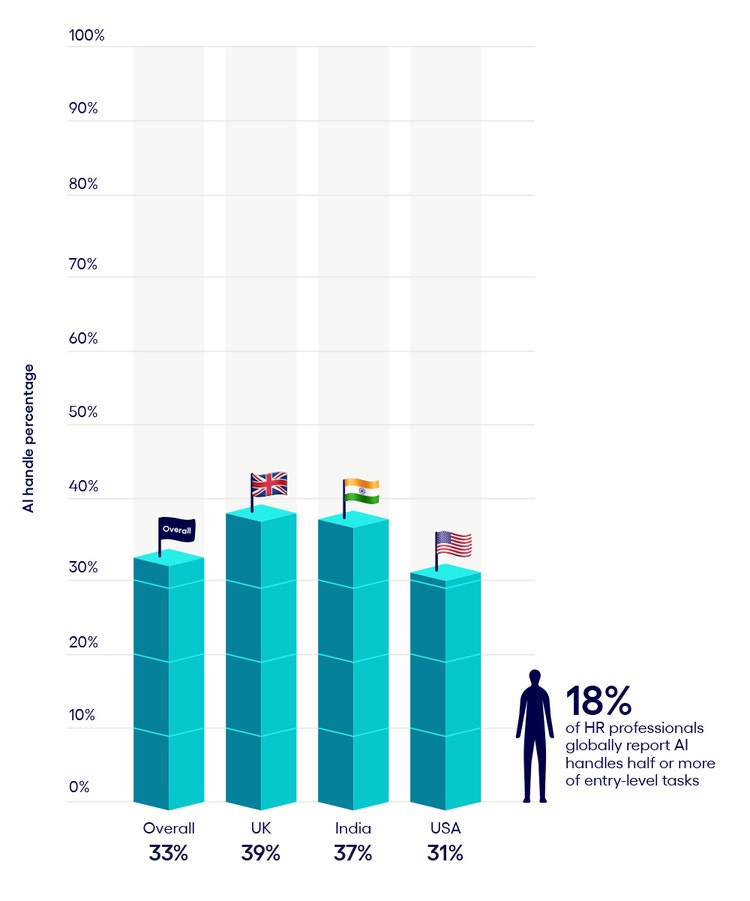
<h3><span class="h4" style="font-weight: normal;">The entry-level playbook has changed</span></h3> <p>The HR playbook for vetting the skills, credentials and potential of recent college grads for entry-level positions has changed nearly overnight. One in three entry-level tasks is now completed by AI, and 18% of HR professionals report that AI handles half or more of the work that once defined a first job, according to a survey of 750 HR professionals at the director-level or above in the US, UK and India working at companies with 1,000 or more employees. This is the defining reality for HR leaders today, and it is reshaping the hiring process from the ground up.</p> <p>Now that AI's transformation of early-career work is underway, enterprises and HR leaders must address whether their hiring frameworks, learning and development (L&D) programs and management structures are keeping pace. Our research suggests many organizations are falling behind at a time when speed matters.</p> <p>This report examines where the talent and skilling gaps are largest, as well as what organizations positioned for long-term advantage are doing differently. Four capabilities emerge from the data as the defining attributes of an AI-era workforce: an <b>AI-native mindset, problem-finding, soft skills and human centricity, </b>and<b> intellectual agility</b>. These four pillars point toward a single organizing principle: adaptability. The organizations that will lead in this environment are those that build the organizational and individual capacity to evolve continuously, at every level of the workforce, to add business value.</p>
<h3><span class="h4" style="font-weight: normal;">The elevated entry-level: Building an AI-first workforce</span></h3> <p><b>AI is completing roughly one-third of all entry-level tasks</b></p>
#
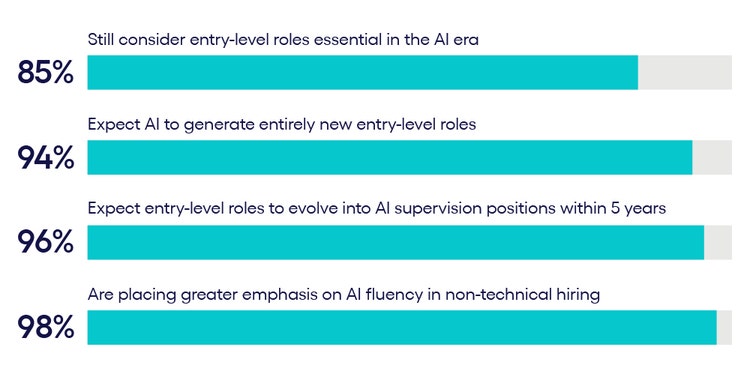
<p><br> The entry-level role is being reimagined in real time, with around one-third of all entry-level tasks being completed by AI. Nearly all HR professionals (96%) expect entry-level roles to evolve within five years into positions where employees largely supervise and manage AI systems rather than perform traditional tasks.</p> <p>One of the most promising findings is that 94% anticipate that AI will generate entirely new entry-level roles that do not currently exist. With this anticipated change and the need to fill the future leadership pipeline, 85% still view entry-level positions as essential in the AI era—the question now becomes what to do with early-career talent once you hire them.</p> <p>The emerging profile of the AI-era entry-level worker looks less like a data entry associate and more like an air traffic controller: someone who manages AI outputs, validates AI decisions, interprets results and escalates edge cases requiring human judgment. In practical terms, this is the AI-native mindset pillar at work. Fluency with AI systems is becoming a baseline hiring criterion; notably, this applies across roles that have never traditionally been defined as technical, like marketing, legal or operations. Ninety-eight percent of HR leaders are now placing greater emphasis on AI fluency when hiring for non-technical roles, a figure that warrants a careful review of current job descriptions, interview processes and onboarding programs through this lens.</p> <p>For graduates, and for the HR leaders recruiting them, the picture here is encouraging. Ninety-nine percent of respondents confirm that AI has already enabled employees to focus more on high-value work. Routine tasks are being handled by AI, and more substantive work is expanding into the space they previously occupied. Early-career roles are evolving into something more demanding and more interesting, and the organizations that recognize this are better positioned to attract, develop and retain the talent that will drive the next decade of growth.</p> <p><b>HR leaders expect new entry-level roles to emerge</b></p>
#
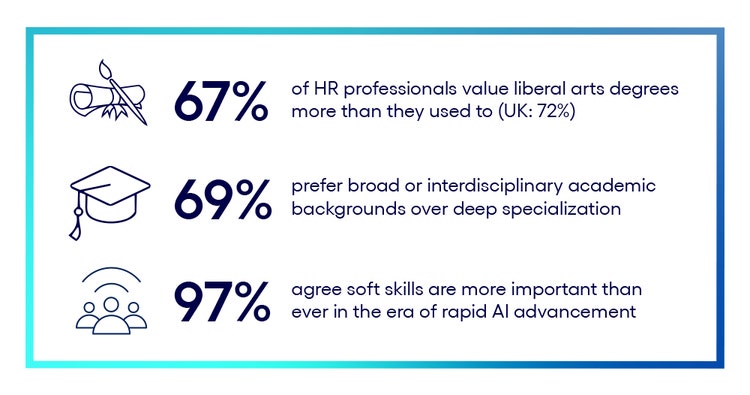
<h3><span class="h4" style="font-weight: normal;">The skills AI can't automate are the ones to invest in today</span></h3> <p>For the better part of a decade, hiring at scale has tilted toward STEM credentials, technical proficiency and deep domain expertise. These preferences reflected a reasonable logic: The economy was rewarding specialization, and employers followed the signal. The survey data presented here complicates that picture in ways HR leaders will want to examine carefully, because the skills that complement and contextualize technical expertise have become significantly more valuable alongside it.</p> <p>Sixty-seven percent of HR professionals now report that they value employees with liberal arts degrees more than they did previously, a figure that rises to 72% in the UK. Sixty-nine percent prefer broad or interdisciplinary academic backgrounds over deep-focus specializations for entry-level hires. And 97% agree that soft skills have become more important in the era of rapid AI advancement. Together, these findings describe a meaningful recalibration in hiring philosophy, one grounded in a clear-eyed view of what AI handles well and what humans do better.</p> <p>As AI absorbs more of the technical execution layer, including tasks that previously required significant STEM training, the capabilities that carry the greatest human premium are those AI cannot easily replicate: judgment, communication, ethical reasoning and creative synthesis. A graduate who can synthesize across domains, navigate ambiguity, communicate clearly to non-specialist audiences and recognize when a technically correct answer is functionally wrong brings a critical kind of organizational value. STEM skills will continue to matter deeply as the world becomes increasingly technical, but the rehabilitation of the liberal arts degree has been an unexpected winner in the AI race.</p> <p><b>Two out of three HR professionals value liberal arts degrees more than they used to</b></p>
#
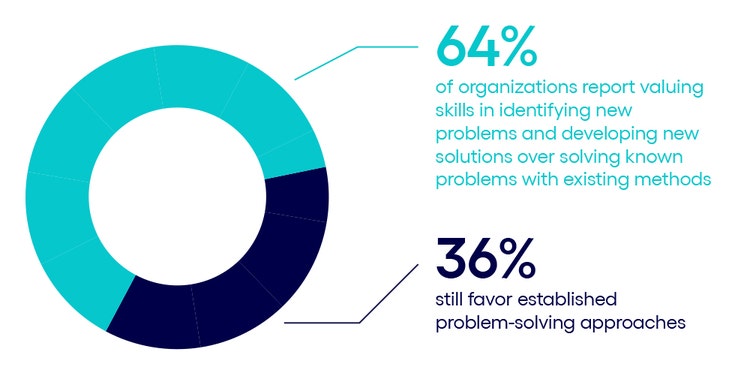
<p><br> The 64% of organizations that report valuing problem-finding over problem-solving illustrates this dynamic precisely. When AI handles execution, the human premium shifts to framing problems, asking better questions and recognizing challenges before they become crises. These capacities develop through broad, humanistic education. A graduate who emphasizes critical thinking and demonstrates comfort with ambiguity carries a structural advantage in environments where the nature of the work keeps changing.</p> <p>This connects directly to the intellectual agility pillar. The pace of occupational change means that narrow specialization, while still valuable in specific contexts, carries a risk it did not carry a decade ago: Expertise calibrated to today's workflows may transfer poorly to the workflows emerging to replace them. Breadth functions as a hedge in that environment, and the HR leaders in this survey appear to recognize it as such. For organizations thinking about long-term talent pipeline strategy, this finding has practical implications for how academic backgrounds are evaluated at the entry level, and for how L&D investments are structured to reinforce adaptability throughout a career.</p> <p><b>Organizations value the ability to identify new problems and develop new solutions</b></p>
#
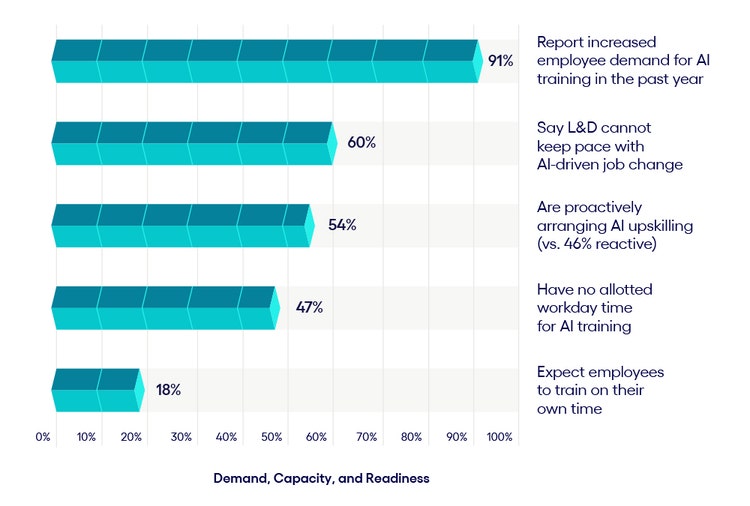
<h3><span class="h4" style="font-weight: normal;">Reactive upskilling is high cost and low return</span></h3> <p>Employee demand for AI training has increased sharply, and a significant share of organizations are not structured to meet it.</p> <p>Ninety-one percent of HR professionals report that employee demand for AI training has increased over the past 12 months. And 60% say their L&D programs cannot keep pace with how quickly AI is transforming jobs. Only 54% of organizations are proactively arranging AI upskilling in anticipation of future role evolution, with the remaining 46% responding to skills gaps after they emerge rather than building capabilities in advance of them.</p> <p>These figures describe a structural problem. Demand for AI training is nearly universal, and a clear majority acknowledge that L&D programs are falling behind; however, many organizations are failing to proactively address this skilling gap. By building a proactive upskilling roadmap, HR leaders will create a pathway to productivity that drives business value rather than patching holes as they appear.</p> <p><b>The upskilling gap: demand, capacity and readiness</b></p>
#
<p><br> This begs a more fundamental question about how AI learning is structured. AI fluency develops through routine exposure, experimentation, application and refinement. It’s a continuous process rather than a certification endpoint, and one that requires integration into the workday rather than relegation to personal time. An approach built around periodic scheduled training sessions doesn’t account for the nature of what is being learned. What actually builds capability is learning embedded in the flow of work: an answer to an in-the-moment question, guidance on the highest-value training for a specific role, the ability to pause mid-task and develop a deeper understanding rather than waiting for a calendar block.</p> <p>The distinction between accommodating upskilling and anticipating it is where competitive differentiation accumulates. Proactive capability-building requires L&D investment upstream of the visible skills gap—identifying what employees will need based on where roles are going, and building infrastructure that moves with the pace of change. The 64% of HR professionals reporting difficulty finding AI-skilled talent are, at least in part, navigating a constraint that can be addressed internally. Hiring cannot substitute for the kind of continuous, embedded capability-building that this moment requires.</p> <p>Cognizant's Skillspring<sup>TM</sup> initiative was developed as a direct response to this structural challenge, as it was designed to move organizations from reactive accommodation to proactive capability-building. Cognizant Skillspring<sup>TM</sup> functions as a learning partner embedded in the flow of work, from answering an in-the-moment question to guiding employees toward the highest-value training for their specific role, to providing in-course support that helps learners clarify and deepen understanding. This architecture reflects a core insight the survey data supports: Meaningful AI learning requires the same adaptive, iterative engagement the technology itself demands.</p> <p>Cognizant brings to this challenge the credibility of having navigated it internally as Client Zero, consolidating job families, building new skill frameworks and transforming workforce development at enterprise scale, not as a theoretical exercise but as a lived organizational experience. Pearson's expertise in learning design, credential frameworks and workforce education extends this architecture further, offering the research-backed foundation that proactive upskilling at scale requires. The collaboration between Cognizant and Pearson reflects a shared premise: Closing the 60% L&D gap requires both organizational commitment and rigorous learning science, applied together.</p>
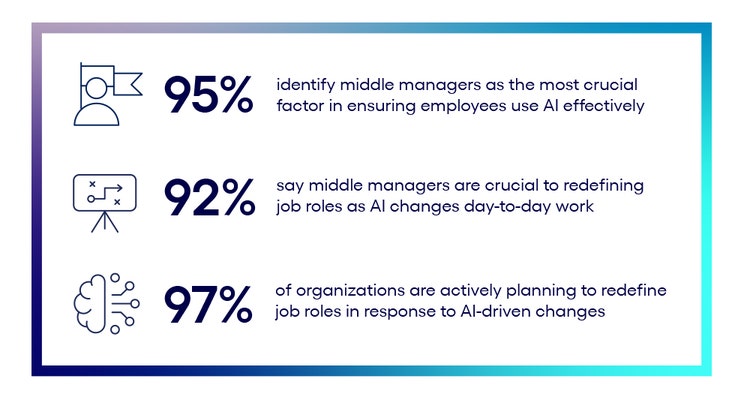
<h3><span style="font-weight: normal;" class="h4">Your middle managers are your AI pilots</span></h3> <p><b>The middle manager is the key to effective AI transformation</b></p>
#
<p><br> The traditional middle management role was built around coordination and oversight, but AI is absorbing a significant portion of that work. What grows in value as a result is distinctly human: judgment, context-setting, coaching and accountability. The soft skills and human centricity pillar, relevant at the entry level, applies with equal force at the management layer.</p> <p>Ninety-five percent of HR professionals identify middle managers as a crucial factor in ensuring employees use AI effectively, and 92% say they are crucial to redefining job roles as AI changes day-to-day work. The most effective middle managers in the AI era look less like traditional supervisors and more like player/coaches: still doing substantive work alongside their teams, modeling AI-enabled workflows in real time, and actively developing team capability rather than simply directing activity. This model, familiar in high-performance domains from sports to consulting to professional services, reflects a well-established principle about how learning transfers most effectively.</p> <p>The player/coach role is also an expression of intellectual agility at the leadership level. Middle managers best positioned to lead AI-era teams are those who can model continuous learning, synthesize across functions and redesign workflows as AI capabilities evolve. While deep subject-matter expertise remains valuable, the primary lever is the capacity to adapt, reframe and develop others in a rapidly changing environment. The 97% of organizations actively planning to redefine job roles in response to AI-driven changes will execute that redesign at the team level, and whether it produces genuine organizational capability or remains a strategic aspiration will depend substantially on whether middle managers have the skills, authority and frameworks to carry it out.</p> <p>In one of the most counterintuitive findings in the research, the middle managers who have been removed in an effort to streamline and flatten organizational hierarchies are now the linchpin in a holistic AI strategy. HR leaders reveal that middle managers providing frontline guidance, coaching and leadership will be a critical touchpoint and translation layer for a successful AI transformation.</p>
<h3><span class="h4" style="font-weight: normal;">The path forward</span></h3> <p>With 60% of organizations struggling to keep pace with AI skilling demands, HR leaders need a clear path forward to develop an AI-first workforce. Our survey findings make clear that the answer is well within reach. Rather than searching far and wide for scarce and costly AI expertise, they can create a talent playbook that is relevant and effective for an AI-driven world.</p> <p>These playbooks should mirror the characteristics of organizations positioning themselves for long-term strength in the AI era: Hire for AI fluency but also for interdisciplinary strength and intellectual agility. Empower people at all levels to identify problems that they—in combination with AI—can solve. Encourage middle management to use their soft skills and human centricity as coaches and role architects.</p> <p>As it turns out, these pillars are not just independent capabilities but a coherent organizational posture oriented toward continuous adaptation: building the capacity to evolve alongside changing conditions rather than pausing to recalibrate when gaps become visible.</p> <p>HR leaders need to approach the workforce strategy with the same curiosity and forward orientation as what they’re working to cultivate in their employees. By doing so, they can build a path to productivity that captures the full business value of AI.</p>
Jump to a section
The entry-level playbook has changed #spy-1
The elevated entry-level: Building an AI-first workforce #spy-2
The skills AI can't automate are the ones to invest in today #spy-3
Reactive upskilling is high cost and low return #spy-4
Your middle managers are your AI pilots #spy-5
The path forward #spy-6
<h5>Authors<br> <span class="h6">Developed in collaboration with Pearson</span></h5>