
The talent architecture imperative: Why AI requires a new blueprint for the workforce
<p><br>
<span class="small">May 21, 2026</span></p>
<h2 class="h6">Based on our experience with an AI-powered workforce, here’s how businesses can redesign careers, roles and skills from the inside out—and how we’re doing it now.<p></p>
</h2>
<p>Artificial intelligence is creating one of the most defining moments for talent strategies in decades, prompting organizations of all sizes and industries to reimagine how work is done and how people grow. Leaders who move with clarity and intent can harness it to unlock new value at the level of roles, careers and individuals. The pace of this work is moving faster, and we are writing a new talent blueprint for the future of work in real time.</p>
<p>The scale of the opportunity is significant. Our <a href="https://uat.cognizant.com/us/en/aem-i/ai-and-the-future-of-work-report" target="_blank">New work, new world</a> study established that 93% of jobs are impacted by AI today, with $4.5 trillion in US labor value exposed. Another recent study, <a href="https://www.anthropic.com/research/labor-market-impacts" target="_blank">this one from Anthropic</a>, found that while the theoretical AI task coverage for computing roles sits at 94%, actual observed task coverage in professional settings is only 33%. That 61-point execution gap shows a clear disconnect between the technology’s capabilities and the current workforce’s ability to absorb and implement them.</p>
<p>At Cognizant, we are building the answer from the inside out, implementing a future-oriented workforce built for the AI era. We are implementing the blueprint in real time, establishing ourselves as Client Zero. Because we’re using ourselves as the test case, our clients gain a methodology that’s already been stress-tested at scale across roles, industries and geographies.</p>
<p>Closing the AI execution gap requires more than adopting new tools. It requires completely reimagining how the work is done, how people move through the organization, and how value is created role by role.</p>
<p>Based on our experience, four shifts matter most:</p>
<ul>
<li>Mapping change at the task and process level</li>
<li>Rebuilding career mobility around trajectories rather than static job structures</li>
<li>Elevating and investing in the individual contributor track as a destination</li>
<li>Explicitly designing roles around the highest-value human contributions.</li>
</ul>
<p>Together, these form a new talent architecture imperative.</p>
<p>AI is changing more than our daily tasks; it is fundamentally changing how our work is organized, how roles are defined, how managers lead and how careers are structured. The organizations that excel in the coming era pair AI deployment with the harder work of redesigning the human architecture around those tools, role by role and pathway by pathway. At its core, the <a href="https://www.cognizant.com/us/en/insights/insights-blog/bridge-to-ai-value-will-be-built-not-bought" target="_blank">true enterprise value of AI will be built, not bought</a>.</p>
<h4>Rebuilding work one task at a time</h4>
<p>The prevailing narrative around AI and jobs operates at the wrong level of analysis. Headlines focus on which professions will be displaced. The more useful question is which tasks within those professions are being restructured. AI is decomposing them, redistributing task loads and creating entirely new and uniquely human work that existing workforce architectures were never designed to accommodate.</p>
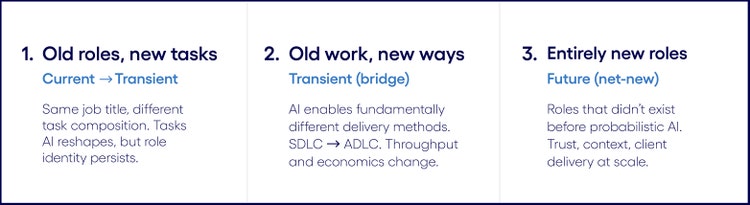
<p>As Cognizant mapped AI exposure across the roles in our organization, we found that the most useful unit of analysis is the task. AI reshapes the task mix inside roles, decomposing work into what can be automated, what can be AI-assisted and what remains uniquely human. From this perspective, three distinct patterns of change emerged. Each requires a different organizational response.</p>
#
<p> </p>
<ol>
<li><b>Old roles, new tasks</b>. Many job titles remain the same, but the work inside them is fundamentally different. The Software Engineer is perhaps the clearest example. Our internal data shows that a developer's time spent on direct coding will shrink, while their time devoted to problem identification and context design will expand. The title stays, but the cognitive center of gravity shifts entirely.<br>
<br>
</li>
<li><b>Old work, new ways</b>. Some roles are being fundamentally restructured end-to-end. Our internal data shows this pattern in the software development lifecycle. The build phase is compressing dramatically, while the need for testing, validation, verification and governance is growing. As a result, overall project effort can decrease, but only when teams thoughtfully reengineer their workflows rather than simply layering new tools on top of existing processes.<br>
<br>
</li>
<li><b>Entirely new roles</b>. AI is generating categories of work that did not exist before, centered on trust, context and human oversight rather than execution. These new roles are emerging from the need to govern AI outputs, verify quality, design the prompts and knowledge structures that ground AI behavior, and evaluate performance in ways that require deep domain fluency combined with AI literacy.<br>
</li>
</ol>
<p>These roles require a new professional profile. At Cognizant, Context Engineer and AI Evaluation Specialist represent a new class of professional labor. <a rel="noopener noreferrer" target="_blank" href="https://www.cognizant.com/us/en/insights/insights-blog/context-engineering-for-reliable-enterprise-ai">We are building the Context Engineering skillset at scale</a>, as it is integral to helping enterprises achieve AI value.</p>
<h4>Redesigning architecture around career trajectories</h4>
<p>Most large organizations manage their workforce through static structures: clusters of related roles grouped by function or skill domain. These architectures were designed for stability, describing where people are today. They were never designed to describe where people need to go—and in a period of rapid, task-level disruption, that limitation becomes a strategic liability. They offer little guidance on transition pathways, create implicit barriers to lateral movement, and make it difficult to track workforce evolution in real time.</p>
<p>Cognizant’s response has been to consolidate approximately 90 legacy job groups into about 20 future-oriented job families. Within each job family are new roles. Each role has a current state, a transient state and an intended future state, along with the bridge learning, experiences and time horizons required to move toward the future.</p>
<p>Additionally, we are creating role groups that span multiple job families and enable associates to move with more agility based on skill, AI fluency and proficiency. </p>
<p>The mobility implications of this shift are significant. Because roles within a job family group are clustered by shared skills and work patterns rather than by historical function, associates can move forward horizontally, laterally and diagonally with far greater fluidity than legacy architecture allows. And crucially, migration can be tracked: Organizations can measure, at any point, the percentage of their workforce in current, transient and future states by job family and by business unit.</p>
<h4>Elevating the individual contributor track</h4>
<p>Perhaps the most consequential implication of AI-driven workforce transformation is what it means for individual contributors.</p>
<p>For decades, the dominant career model in knowledge-intensive industries sent an unmistakable signal: Advancement means management. Technical depth, however exceptional, was largely treated as a stepping stone to people leadership rather than a career destination in its own right. </p>
<p>The result: Exceptional individual contributors moved into management roles they neither wanted nor excelled at, and organizations were deprived of the deep expertise these individuals could have continued to generate.</p>
<p>The AI era disrupts this model fundamentally. The roles that are emerging as most valuable in AI-native organizations are, in many cases, held by individuals rather than managers. A Context Engineer building the knowledge architecture that powers an enterprise AI ecosystem exercises a form of leverage that has no real precedent in traditional workforce models. An LLM specialist fine-tuning foundation models for domain-specific applications is solving problems that entire teams could not have solved a decade ago. As AI increases the leverage of deep expertise in context engineering, evaluation and assurance, model specialization and domain-grounded solution design, some of the most valuable work concentrates in high-impact individual contributor roles.</p>
<p>Associates across backgrounds often show the steepest productivity gains when given the right tools and context. Cultivating a workforce with these interdisciplinary skillsets is a key differentiator.</p>
<p>Organizations that recognize this shift and build career architecture to support it—with parallel technical and managerial tracks that offer equivalent levels, compensation and recognition—will gain a durable competitive advantage. In an era where individual AI fluency can amplify personal output by a factor of two or three, the individual contributor is one of the highest-leverage assets in the organization.</p>
<h4>Building an interdisciplinary skills model</h4>
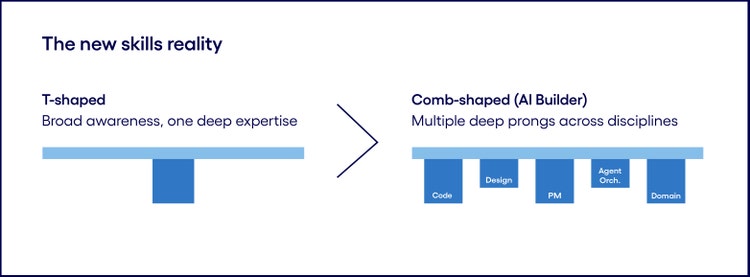
<p>The skills implications of this transformation extend well beyond technical literacy. The workforce model that served knowledge workers for the past two decades—deep expertise in one domain, broad awareness of adjacent areas, the so-called T-shaped professional—is giving way to something more complex and more powerful.</p>
<p>Our skills approach builds a more comb-shaped professional: someone with deep skills across multiple areas, including both technical and human-centric domains. Coding, design, project management, agent orchestration, domain knowledge—these are converging into integrated capability clusters rather than separate specializations. </p>
<p>As AI commoditizes an expanding set of technical capabilities, the primary differentiator in professional value is shifting toward the combination of industry expertise and human judgment: the ability to understand context, navigate ambiguity, apply ethical reasoning, communicate across stakeholder groups and translate between machine capability and business outcome.</p>
<p><b>“Project management, design and coding increasingly converge.” – Ravi Kumar</b></p>
#
<p> </p>
<p>AI tools now available accelerate the acquisition of non-adjacent skills in ways that were previously impractical, making genuinely heterogeneous expertise achievable for the first time. Our experience shows that associates across backgrounds and starting points often show steep productivity gains when given the right tools, context and pathways—a powerful signal that this model is within reach for a much broader population than traditional skills frameworks would suggest.</p>
<p>Making this shift real at scale requires a skilling ecosystem that is both mature and deeply integrated into how the company runs. Cognizant has spent decades building the learning, certification and talent-mobility mechanisms that enable re-skilling at the enterprise level. </p>
<p>Our proprietary Cognizant Skillspring platform adds a critical sensing layer, continuously mapping skills supply and demand, surfacing emerging capability gaps and guiding people toward tailored learning pathways. <a href="https://news.cognizant.com/2026-04-21-Cognizant-Propels-AI-Workforce-Training-with-Cognizant-Skillspring-TM-New-Talent-Transformation-Platform-Designed-to-Accelerate-Clients-Workforce-AI-Readiness" target="_blank" rel="noopener noreferrer">Cognizant Skillspring</a> is redefining learning through a fully conversational interface that maps skills directly to roles, projects and performance outcomes, and adapts learning paths as roles and skill requirements evolve.</p>
<p>In an environment where roles evolve faster than job descriptions, the combination of institutional learning infrastructure and real-time skills intelligence is what turns the comb-shaped model from an aspiration into an operating reality.</p>
<h4>Reclaiming human work and expanding it into new value</h4>
<p>The conversation about AI and the workforce has, understandably, focused on what AI will change. The more generative question—and ultimately the more important one—is what AI makes possible for the first time.</p>
<p>Every organization carries an invisible deficit. It is the sum of all the high-judgment, high-impact work that never got done, as time and cognitive energy were consumed by administrative load. This is the analyst who spent 60% of her week preparing status reports rather than synthesizing strategic insight. Or the HR leader whose days were absorbed by transactional processing rather than thinking deeply about talent and culture.</p>
<p>AI changes this equation fundamentally. As administrative and transactional tasks shift to AI agents—routine queries, status tracking, data reconciliation, scheduling, reporting—the human hours previously absorbed by that work become available. The question is whether organizations will be intentional about what fills them.</p>
<p>The first step is identification: As roles are redesigned, organizations must explicitly map what is uniquely human within each role. This is a matter of identifying what human judgment, human relationships, human creativity and human contextual wisdom contribute that no AI system can replicate. These are the highest-value contributions in the organization, and they have historically been crowded out by lower-value work that was easier to measure.</p>
<p>The second step is more demanding—and more exciting. Protecting the uniquely human work that already exists is only the beginning. The most forward-thinking organizations will ask a more ambitious question: What high-impact work has never been done at all, precisely because the people capable of doing it were never free enough to attempt it? What strategic problems went unaddressed because the leaders who could have solved them were buried in operational noise? What innovations were never pursued because the engineers who could have pursued them were maintaining legacy systems?</p>
<p>The industry has focused too intently on how AI can automate work vs. how it creates the cognitive and temporal space for an entirely new category of human contribution. At Cognizant, this imperative shapes how we think about role group design. Defining the future state of a role is not simply a matter of substituting AI tasks for human ones. It requires asking what the highest and most distinctive human contribution within that role could be—and then designing the role around that answer.</p>
<h4>A framework for what comes next</h4>
<p>The research and talent architecture described here point toward a set of strategic imperatives for organizational leaders navigating this transition.</p>
<ul>
<li><b>Redesign talent architecture around trajectories and pathways.</b> Careers are evolutionary pathways. Organizations need to outline role constructs that define current, transient and future states, and bridge programs that make movement between them tractable and trackable and create role groups that cross over job families to increase the fluidity and agility to move around the organization.<br>
<br>
</li>
<li><b>Make workforce evolution measurable.</b> The transition from current to transient to future states should be a tracked operational metric, with real-time visibility into where the workforce sits on this continuum.<br>
<br>
</li>
<li><b>Invest in the individual contributor track with the same seriousness as management development.</b> The AI era creates unprecedented opportunity for technically deep individuals. Organizations that build parallel career tracks will attract and retain their highest-value technical talent.<br>
<br>
</li>
<li><b>Map the uniquely human work in every role</b>—<b>then go further.</b> Role redesign begins with an explicit accounting of what human judgment, creativity and relationship contribute that AI cannot replicate. Then, identify the high-impact work that has never been done because the people capable of it were never free enough to attempt it—and design roles around that possibility.<br>
<br>
</li>
<li><b>Build learning infrastructure for continuous change.</b> In the AI era, learning becomes part of how work happens—embedded, adaptive and aligned to roles as they evolve. This requires AI-native systems—like Cognizant Skillspring—that combine dynamic learning pathways, real-time skills intelligence, continuous assessment and integration into daily workflows.</li>
</ul>
<p>At Cognizant, <a href="https://www.cognizant.com/us/en/about-cognizant/ai-builder">our commitment as AI builders</a> is clear. We are a proving ground for a talent architecture stress-tested at scale, so that every client we serve gains a highly skilled, future-oriented team that is growing ahead of technology transformations, along with proven talent strategies they can scale.</p>
<p>The deepest opportunity in all of this is human. For the first time in the history of knowledge work, we have the tools to systematically remove the administrative burden that has crowded out the highest-value human contribution. AI, deployed thoughtfully, finally sets that capacity free.</p>
<p>The organizations and individuals who engage with that work—who help imagine and construct what comes next—will find that the AI era is not the end of meaningful work. It is the most expansive chapter yet.</p>

Kathy leads all aspects of people strategy at Cognizant, guiding how the company attracts, develops, engages and rewards its diverse global workforce. She is focused on ensuring Cognizant remains an employer of choice in the industry.