
Prioritizing AI use cases to ensure success in the factory of the future
<p><br> <span class="small">January 29, 2026</span></p>
<p><b>Here’s what it will take for manufacturers to succeed with their AI use cases and investments.</b></p>
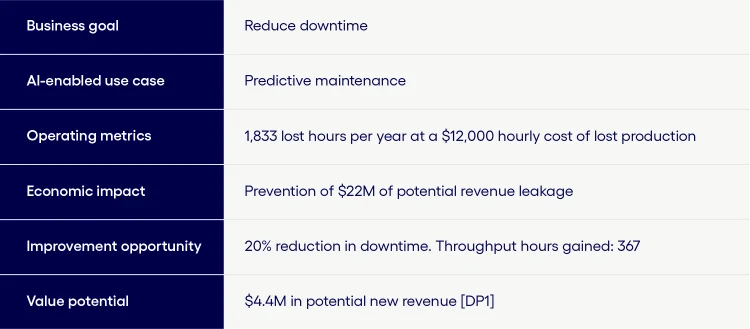
<p>Manufacturers are increasingly <a href="https://www.cognizant.com/us/en/industries/manufacturing-technology-solutions" target="_self">looking to AI to drive positive change</a>, from increased resilience to modernized operations, to enhanced worker productivity. </p> <p>With all of AI’s potential, however, it can be difficult to prioritize which initiatives to pursue first. With many business functions vying to apply AI in their own area of the organization, attention can be diluted and the potential for success, diminished. So, where to begin? </p> <p>At this stage, it’s crucial for manufacturers to avoid being lured in by the hype that has accompanied AI’s rapid acceleration. The “fear of missing out” on the latest advancement can push investment decisions in the wrong direction. It’s important for manufacturers to let business needs dictate their AI decisions.</p> <h4>How to prioritize AI use cases in manufacturing</h4> <p>In other words, value creation doesn’t start with technology. Instead, it starts with the business problem, whether it’s increasing market share, improving brand reputation or growing profit margins. Manufacturers need to prioritize the appropriate AI use case depending on the desired impact.</p> <p>For instance, if market share is the primary goal, the manufacturer could look at how to deploy AI in the new product introduction process. This could help the company better forecast demand and increase speed to market. If the goal is to win more orders by cutting lead times, the manufacturer could integrate AI into its supply chain and asset management solution to help remove inventory bottlenecks and increase fulfilment capacity.</p> <p>Alternatively, perhaps the manufacturer is intent on increasing profit margins. In this case, it could cut its materials consumption by deploying an AI-enabled process optimization solution. If it needed to boost revenues, it could implement an AI-enabled predictive maintenance solution that would improve machinery reliability and increase production uptime. </p> <h4>Building the business case for AI investments</h4> <p>In an ideal world, manufacturers would do all of the above. But the reality is that resources are finite. It can also be impractical to roll out multiple AI projects simultaneously. To decide on which AI initiative to prioritize, manufacturers should build a business case for each project and evaluate the potential return from each solution. </p> <p>It might be determined, for example, that investing $1.1M into a predictive maintenance solution could increase revenues by $4.4M per year and deliver a fourfold return within a one- to two-year window. Meanwhile, the manufacturer might calculate that making a similar investment in an alternative option, a process optimization solution, would only deliver a threefold return over the same period. The clear choice would be to prioritize predictive maintenance.</p>
<h4>Four additional imperatives for the factory of the future</h4> <p>Beyond prioritizing AI investments, we also advise manufacturers to adhere to the following four imperatives:</p> <ul> <li><b>Bring together data from new and legacy assets. </b>AI solutions need access to data. With their reliance on legacy systems, however, manufacturers can experience many visibility gaps. The solution is to convert data into a usable format that can be analyzed and is usable by AI. Cloud and edge computing also play a role here.<br> <br> </li> <li><b>Embed cybersecurity from day one. </b>AI reliance on data introduces new risk vectors for cyber-attacks. To prevent security breaches, AI solutions should prioritize security at all times, particularly when it comes to asset discovery, network segmentation, live threat detection and the development of an IT/OT security operations center.<br> <br> </li> <li><b>Prepare for autonomous AI agents. </b>AI agents today can take action with minimal human intervention. The long-term vision is for agents to communicate and share information among themselves. Manufacturers should conduct pilot programs before scaling agentic systems across production lines and plants.<br> <br> </li> <li><b>Enable workers to interact easily with AI tools. </b>To successfully interact with AI, workers will need an intuitive, easy-to-use human-machine interface. This will encourage acceptance and minimize training.</li> </ul> <h4>Moving toward the factory of the future</h4> <p>By bringing all these elements together, businesses can maximize the value of AI across their operations. In doing so, they will be able to follow a future-ready roadmap that accelerates their move to the factory of the future.</p> <p><i>For more on this topic, see our new guide,</i> “<b><i>Engineering AI into the factory of the future.” </i></b><i>The guide provides guidance on building business cases, deploying a unified namespace (UNS) solution for data management, taking a four-step approach to cybersecurity, preparing for agentic AI systems and developing human-machine interfaces, alongside a framework for organizational change management. <br> </i><a href="https://www.cognizant.com/us/en/cmp/engineering-ai-into-the-factory-of-the-future" target="_blank" rel="noopener noreferrer"><b><i>Download the whitepaper</i></b></a><i>.</i></p>

<p>Sharath is the global offering leader for Cognizant’s Intelligent Operations portfolio, which includes smart manufacturing, smart warehouses and smart utilities. He is also responsible for IoT business development across the manufacturing, energy and utilities, and transportation sectors in the Americas—with a focus on engineering R&D, smart manufacturing and field services.</p>