
AI in financial services: Where reinvention really begins
<p><br> <span class="small">March 18, 2026</span></p>
<p><b>Firms are settling for optimization. They should be striving for true reinvention.</b></p>
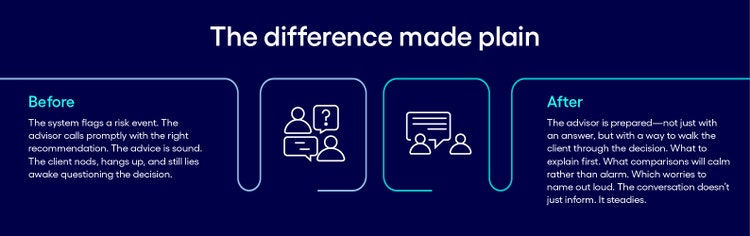
<p>It’s a weekday evening. A retail investor—mid 50s, still working, retirement not far off—sits at the kitchen table. The phone buzzes. Another market alert. Another ugly headline.</p> <p>They open their account. The balance is down more than they’re comfortable admitting out loud.</p> <p>They think about the college loans they’re still helping with. The house. The date they’ve circled in their head when work is supposed to slow down, then stop.</p> <p>They don’t want a chart. They don’t want a lecture about long-term averages. They want someone to help them answer a very plain question: Am I about to make a mistake I’ll regret?</p> <p>They want help thinking straight when fear is doing most of the talking.</p> <p>That’s the moment that matters. That’s the service. It always has been.</p> <h4>The role of AI in wealth management</h4> <p>Wealth management is often cited as a natural home for artificial intelligence. On paper, this makes sense. After all, the business runs on numbers: returns, projections, probabilities.</p> <p>So the instinct is predictable. Al means better advice. Better allocations. Better forecasts. If advisors give better answers, clients will stay and assets will grow.</p> <p>This is all reasonable. But it’s also incomplete.</p> <p>People don’t usually leave an advisor because a portfolio underperformed by a point or two. They leave after moments that feel unsettling—when markets fall fast, when retirement suddenly feels close, when a decision shows up that can’t be undone.</p> <p>They leave when they feel alone with a choice.</p> <p>For all our sophistication, the hardest part of investing has never been the math. It’s the human part.</p> <p>Which leads to a simpler, truer way of putting the problem: Clients don’t hire advisors just to know what to do. They hire advisors to help them decide what to do.</p> <p>Once AI enters the picture, that difference matters more than ever. AI can absolutely help with the decision, but only if it supports the human part of the work, not just the math. Otherwise, it risks making recommendations faster while leaving clients just as alone with the choice.</p> <h4>The limitations of predictive AI in financial services</h4> <p>Because financial services firms know that big decisions tend to arrive at life moments—retirement, job changes, inheritances, market shocks—the next AI-related move seems obvious: Use AI to spot those moments early.</p> <p>So tools are built to flag signaling behaviors such as cash moving, contributions changing or risk tolerance shifting.</p> <p>Advisors get notified. They reach out.</p> <p>This is progress. It’s better than silence. But it’s not enough.</p> <p>Knowing when a decision is coming doesn’t help someone make the decision itself. It tells you uncertainty is in the room. It doesn’t tell you what the person is afraid of, what tradeoffs they believe they’re facing, or what story they’re telling themselves at that kitchen table.</p> <p>Finding the crossroads is not the same as helping someone choose a direction.</p> <h4>The full value of AI to financial services advisors</h4> <p>This brings me to a point about reinvention.</p> <p>There is a sentiment that frequently shows up in corporate conversations about AI: We have to move from optimization to reinvention.</p> <p>Optimization is easy to imagine. You take what you already do and make it faster, cheaper, smoother. Same work. Fewer rough edges.</p> <p>Reinvention sounds larger. Loftier. And that’s usually where the trouble starts. The boardroom talk fills with platitudes about new models, new value, new experiences. It all sounds important. It rarely sounds clear.</p> <p>Financial services firms seeking genuine reinvention should start but by asking a better question.</p> <ul> <li>Most organizations start here: How do we do this better?</li> <li>The ones that truly change start here: Is this still the right thing to be doing?</li> </ul> <p>That question has a way of clearing the air. It pulls the conversation out of theory and drops it back into real life—into how people actually behave when the stakes are real.</p> <p>The real value of AI in advice is not in predicting the moment. It’s in helping navigate the moment.</p> <p>Not just prompting an advisor to call, but helping the advisor know how to show up for this client, right now.</p> <p>That means understanding how a person tends to decide.</p> <ul> <li>Do they panic when losses appear, even small ones?</li> <li>Do they want options laid out, or do too many choices make things worse?</li> <li>Do facts calm them, or do facts make them spiral?</li> <li>When they ask for analysis, are they really asking for reassurance?</li> </ul> <p>This kind of help doesn’t replace the advisor. It supports the part of the job that’s hardest to train and hardest to scale: guiding someone through uncertainty without letting fear hijack the outcome.</p>
#
<p><br> The goal isn’t speed. It’s clarity that lasts past the call.</p> <h4>Why this counts as reinvention</h4> <p>Optimization improves answers.</p> <p>Reinvention improves judgment.</p> <p>In an optimized world, success means delivering the correct recommendation efficiently.</p> <p>In a reinvented world, success means helping someone reach a decision they can live with—and stick to—after the anxiety fades.</p> <p>Spotting life events matters. It just doesn’t finish the job. The real value appears when technology helps humans think clearly at the exact moment clear thinking is hardest.</p> <p>When that happens, the advisor’s role changes. They are not a dispenser of expertise. Not just someone who calls at the right time. They are a steady presence when the ground feels unsteady.</p> <p>Advice stops looking like a product and starts looking like support—something you lean on when things wobble.</p> <p>Confidence in a decision becomes the service.</p> <h4>The future of AI in financial services</h4> <p>Most organizations struggle with AI for a simple reason: they attach new intelligence to old aims. They settle for optimization, using tech to make calculations faster when what people are really paying for is help with judgment.</p> <p>Reinvention begins the moment a firm admits what its customers were buying all along—even when no one quite said it out loud.</p> <p>In financial advice, it was never just the plan.</p> <p>It wasn’t the model.</p> <p>It wasn’t even the timely phone call.</p> <p>It was help staying steady when doubt showed up uninvited.</p> <p>AI’s real contribution is not that it makes advisors smarter. It’s that it makes their true job unmistakable.</p> <p>Wherever the work involves judgment, regardless of whether the topic is money, health, trust or risk, the question is the same. Stop asking how to do yesterday’s work faster. Start asking what the work is meant to protect, preserve or make possible for a human being.</p> <p>Reinvention does not begin with better tools. It begins with the courage to ask better questions.</p> <p><i>In future pieces, we’ll look at other places where progress begins the same way—not with better outputs, but with better questions.</i></p> <p><i><a href="/content/cognizant-dot-com/us/en/industries/capital-markets-technology-solutions/wealth-management.html" target="_blank" rel="noopener noreferrer">Digital Wealth Management Solutions | Cognizant</a></i></p>

<p>Ed is a Vice President in the Banking and Capital Markets Group. He is responsible for advising CIO and CTOs on execution strategies for technology-driven operational improvement, transformation and innovation initiatives. He participates both as a Consultant and a Delivery Leader.</p>