
Making agentic AI ROI real in the contact center
<p><br> <span class="small">May 19, 2026</span></p>
Making agentic AI ROI real in the contact center
<p><b>Customer experience leaders need clear metrics to validate AI’s impact. With the right ROI framework, they can get the proof points they need, starting with a single customer interaction.</b></p>
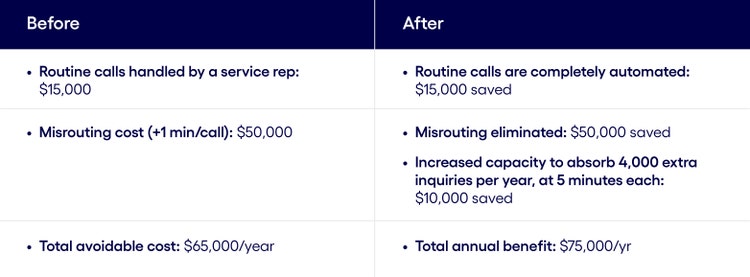
<p>Few business functions are experimenting with AI as much as customer support. <a rel="noopener noreferrer" href="https://www.inno-thought.com/post/gartner-says-the-most-valuable-ai-use-cases-for-customer-service-and-support-fall-into-four-areas" target="_blank">In recent Gartner research</a>, 77% of service and support leaders feel pressure from other senior executives to deploy AI. This ranges from AI chatbots to agentic AI solutions <a href="https://www.cognizant.com/us/en/insights/insights-blog/bots-to-ai-agents-for-customer-experience" target="_blank">that can resolve complex, multi-step customer issues</a>.</p> <p>However, the vast potential of deploying AI in the contact center won’t go anywhere without proof of its value. Very often, the value that seemed obvious during the proof-of-concept or pilot phase becomes hard to defend when it’s time to scale. In fact, according to Gartner, <a rel="noopener noreferrer" href="https://www.gartner.com/en/newsroom/press-releases/2025-06-25-gartner-predicts-over-40-percent-of-agentic-ai-projects-will-be-canceled-by-end-of-2027" target="_blank">over 40% of agentic AI projects will be canceled</a> by the end of 2027 due to escalating costs, unclear business value, or inadequate risk controls.</p> <p>Before getting started with their AI initiatives, organizations need to take a structured approach to ROI and ensure the right metrics are in place from the start. In our work with customer experience (CX) leaders, we’ve selected and applied industry-accepted ROI framework tools to establish pre‑deployment baselines and validate post‑deployment outcomes.</p> <p>Bottom line: When a single customer interaction is measured through the right ROI lens, the value of agentic AI becomes undeniable. By using a before-and-after analysis of cost, time and effort, customer support leaders can gain the transparency, governance and confidence needed to scale agentic AI across the contact center.</p> <h4>Using an ROI framework to unlock AI scale in CX</h4> <p>The typical steps of a consulting-led measurement approach start with a single customer pain point and proceed from there. Here’s how this might look at a hospital contact center:</p> <ol> <li><b>Anchor on a real customer scenario.</b> CX leaders need to identify a specific, recurring interaction that drives cost and friction today. A typical scenario might entail a patient calling to inquire about a billing discrepancy. Traditionally, the service rep would search multiple systems, clarify the policy and possibly schedule a follow-up call. All these steps combined drive longer handle times and repeat calls.<br> <br> </li> <li><b>Define success metrics.</b> They then need to choose the two or three metrics that will prove value. In this scenario, success metrics would center on reductions in average handle time (AHT) and increases in customer satisfaction scores (CSAT).<br> <br> </li> <li><b>Establish a baseline before deployment.</b> This entails a precise documentation of current-state costs, volumes and experience scores.<br> <br> </li> <li><b>Apply an established ROI framework.</b> Using a framework <a rel="noopener noreferrer" href="https://techcommunity.microsoft.com/blog/azure-ai-foundry-blog/a-framework-for-calculating-roi-for-agentic-ai-apps/4369169#community-4369169-mcetoc\_1ii7b49bt\_1" target="_blank">like this one from Microsoft</a>, businesses can then calculate both tangible savings and intangible benefits from the proposed solution: a virtual agent that would analyze the issue, surface the correct policy, recommend the next best action and autonomously trigger a confirmation follow-up.<br> <br> </li> <li><b>Compare and contrast.</b> With this information, CX leaders can compare outcomes against the baseline to demonstrate a clear correlation between the solution and the outcome.<br> <br> In this case, the agentic solution would reduce the number of calls that reps need to handle and minimize misrouted calls, which would improve average handle time. Gains in customer satisfaction would reflect improved routing friction and faster, more consistent resolution.</li> </ol> <h4>Modeling out a real-world example of AI ROI in CX</h4> <p>Here’s what this might look like based on our experience with a variety of contact center clients. The following modeling exercise assumes:</p> <ul> <li>100,000 customer inquiries per year</li> <li>A customer service rep cost of $0.50/min</li> <li>10% of all calls are routine, lasting about three minutes each</li> <li>Misrouting adds about one minute to each inquiry, on average</li> <li>The baseline AHT is 5 minutes/call</li> </ul> <p>If you also assume that an agentic solution could handle all the routine calls and minimize misrouted calls, the before-and-after scenario looks like this:</p>
#
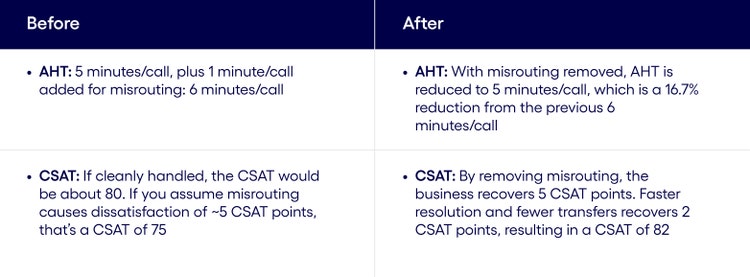
<p><br> Now let’s look at the before/after picture for the key metrics of AHT and CSAT.</p>
#
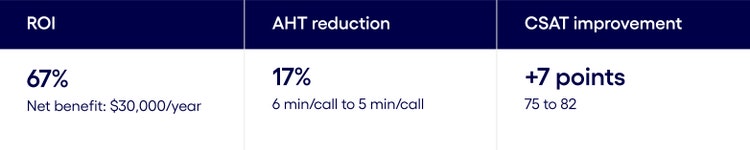
<p><br> With implementation and integration costs of $40,000 and annual maintenance of $5,000, the total annual cost of the system would be $45,000. With $75,000 in savings, that yields a net benefit of $30,000 per year, for an ROI of approximately 67%.</p>
#
<h4><br> Intangible benefits of using AI for CX</h4> <p>While the tangible savings can justify the investment, the durable competitive advantage often comes from the intangible gains. A complete ROI story needs to account for both.</p> <p>In this case, the intangible benefits include:</p> <ul> <li>Fewer transfers and faster resolution reduce patient frustration</li> <li>It becomes easier to absorb seasonal spikes without adding headcount</li> <li>Less repetitive work and fewer angry callers lower agent burnout</li> <li>Consistent, accurate responses strengthen institutional credibility</li> </ul> <h4>From experimental to scaled AI in CX</h4> <p>The discipline of establishing baselines, selecting the right metrics and validating outcomes builds the organizational muscle that allows AI to scale responsibly. And it can convert AI from an experiment into a measurable business accelerator.</p> <p>By combining established ROI frameworks with consulting-led CX expertise, organizations can move from pilots to scalable deployments, with the proof to back every step.</p>

<p>Purojit Mitra, a results-oriented Functional Lead at Cognizant Moment, is an AI, CX and CRM advisory professional with over seven years of experience driving enterprise transformation. He specializes in agentic and generative AI, shaping scalable solutions and helping organizations translate emerging technologies into measurable, customer-centric outcomes globally.</p>