
Cognizant tackles AI complexity—with powerful results
<p><br>
<span class="small">May 01, 2026</span></p>
<h2 class="h6">As an AI builder, the company has deployed one of the largest enterprise multi-agent AI systems, transforming the digital workplace for its 350,000 employees.<p></p>
</h2>
<p>In most enterprises, productivity is quietly slowed by fragmentation across digital workplaces. Employees toggle between multiple portals, search across disconnected systems, raise tickets for routine needs and navigate layers of process just to complete simple tasks. When organizations introduce new AI agents and digital tools, the experience can sometimes become even more complex, as employees must determine which system or agent to use for each task.</p>
<p>From Cognizant’s perspective, the challenge was not a lack of AI innovation, but too much fragmentation. Teams were adopting tools and agents in silos, increasing complexity, support burden and governance risk. The mandate behind OneCognizant (1C) was clear: simplify the employee experience, centralize control without slowing innovation and create a single, scalable operating layer for enterprise AI.</p>
<p><a href="https://www.cognizant.com/us/en/about-cognizant/ai-builder">As an AI builder</a>, Cognizant saw an opportunity to change that dynamic by using our own inter-operable, scalable, extensible AI multi-agent platform to address this complexity. 1C was built as <a href="https://www.cognizant.com/us/en/about-cognizant/ai-builder/client-zero">Cognizant’s Client Zero</a>; we made a deliberate decision to prove AI-driven enterprise transformation internally, at full organizational scale, before taking the model to clients. Every architectural choice, governance mechanism and agent workflow was validated first within Cognizant’s own operations.</p>
<p>The revitalized 1C platform was designed to unify hundreds of enterprise applications and AI agents into a single, intuitive, searchable interface across web and mobile. Instead of requiring employees to navigate multiple systems, we redesigned the platform around employee experience. The result is a cloud-native, AI-powered digital front door that simplifies work for 350,000 users worldwide, personalizes interactions and brings intelligent automation into everyday workflows.</p>
<p>Built using the Cognizant Neuro® AI Multi-Agent Accelerator (<a href="https://github.com/cognizant-ai-lab/neuro-san-studio" target="_blank" rel="noopener noreferrer">neuro-san</a>), 1C now integrates third-party enterprise applications and proprietary AI agents into one cohesive experience. Intelligent search capabilities take associate behavior and suggest relevant actions, reducing the time spent navigating menus. Process flows are automated using a proprietary AI agent orchestration method to eliminate redundancy, making common tasks faster and more intuitive.</p>
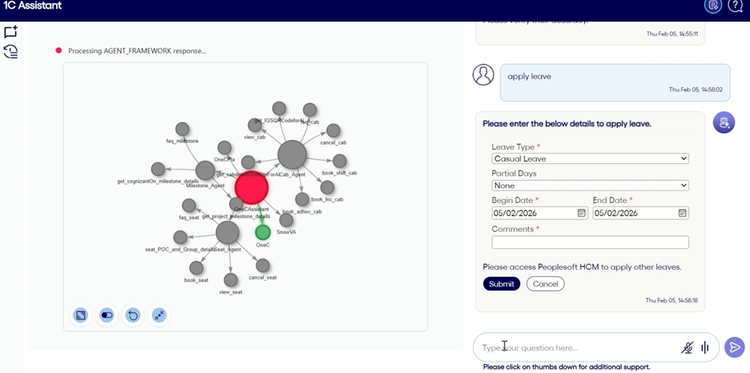
<p>Employees can complete tasks such as applying for leave (see figure below, or <a href="https://www.youtube.com/watch?v=abVGs6RL3iI" target="_self" rel="noopener noreferrer">watch video demonstration here</a>), booking office seating, reserving transportation, or requesting hardware and software through integrated ServiceNow agents. These services can also be combined within a single interaction, allowing multiple requests to be handled seamlessly through coordinated agent workflows.</p>
#
<p><br>
Beyond technology consolidation, 1C represents a new operating model for enterprise IT, one where the CIO function acts as the steward of an agentic ecosystem. Business teams retain flexibility to innovate, while the CIO function ensures consistency, security and lifecycle management across hundreds of applications and AI agents.</p>
<h4>The outcome</h4>
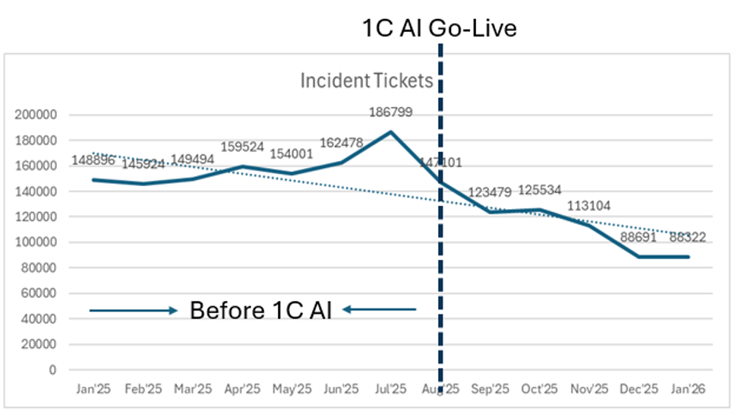
<p>Within only five months of its rollout in July 2025, agentification in 1C has revolutionized workplace operations. By aggregating key actions into a single platform and embedding AI into the core experience, 1C has delivered a 50% improvement in operational efficiency, and support ticket volumes have dropped by approximately 50%, easing the burden on service teams and reducing friction for employees. Employee engagement has risen by 35% with 10,000 average daily users, reflecting a shift from transactional interaction to intuitive digital enablement.</p>
<p>"<i>1C is not just a digital workplace upgrade, it’s a fundamental shift in how we run the enterprise. As our Client Zero, 1C allows us to unify applications, data and AI agents into a single operating layer, reducing complexity for our employees while enabling us to scale AI responsibly across the organization. What we’ve built internally is now a proven blueprint for enterprises looking to move from isolated AI tools to truly agentic operations.” </i>— <b>Neal Ramasamy, CIO, Cognizant</b></p>
#
<p><br>
The scale of impact is equally significant. The platform has facilitated more than 10 million agent actions with 92% positive user feedback, while delivering response times that are twice as fast as before. Under the hood, the architecture has expanded platform capacity by 350%, ensuring the foundation can support growing adoption and future innovation.</p>
<p>Beyond modernizing the enterprise intranet, the revitalized 1C platform represents a new operating model—one in which enterprise apps and AI agents are not scattered across systems but orchestrated into a unified experience. As organizations continue to adopt AI at scale, the ability to bring intelligence, governance and usability together in one interface will define the next phase of enterprise productivity.</p>
<p>This model also provides a blueprint for enterprise agentification, with an extensible nucleus created, verified, sandboxed and launched by the CIO department. The platform includes a structured process that empowers different departments to develop in-house or provision third-party agentic systems. Following the verification and sandboxing process, these agents can be plugged into the larger multi-agent nucleus, becoming discoverable by authorized users and capable of being used in conjunction with other agentic capabilities in the system.</p>
<p>Enterprises facing similar issues, such as organizational silos, complex workflows and legacy IT stacks, may consider agentifying their business. Neuro® AI Multi-Agent Accelerator provides a strong starting point. Because it is open source and both LLM- and cloud-agnostic, it enables organizations to build agentic systems without being locked into a vendor ecosystem. With the agent network designer, teams can quickly vibe-code an agentic network tailored to their specific use case and then scale, extend and iterate from there.</p>
<p>“With 1C, we’ve built one of the largest enterprise-wide multi-agent systems in operation today,” said Babak Hodjat, Chief AI Officer at Cognizant. “As organizations move from isolated AI tools to multi-agent workflows, many are discovering a significant skills and infrastructure gap in how to scale and govern these systems safely. Our work on 1C—combined with open innovations like the Neuro AI Multi-Agent Accelerator—demonstrates how enterprises can orchestrate hundreds of agents and sub-agent networks while maintaining control, reducing vendor lock-in and enabling interoperability across diverse agent ecosystems.”</p>
<p>For CIOs facing similar challenges—organizational silos, growing AI tool sprawl and increasing pressure to deliver productivity gains—1C demonstrates how an agentic enterprise can be built responsibly. By unifying experience, governance and automation into a single platform, Cognizant has turned its internal transformation into a repeatable blueprint for enterprise‑scale AI adoption.</p>
<h4>Key outcomes for 1C: Measurable impact at scale</h4>
<p>The revitalized 1C platform delivered significant, measurable results:</p>
<ul>
<li><b>50% efficiency improvement</b> driven by AI-powered automation and intelligent workflows</li>
<li><b>50% reduction in support tickets</b>, lowering operational overhead</li>
<li><b>35% increase in associate engagement</b>, reflecting improved experience and adoption</li>
<li><b>Over 10 million agent actions delivered with 92% positive feedback</b>, at <b>2X faster response rates</b></li>
<li><b>350% increase in platform capacity</b>, enabling scalable growth</li>
</ul>
<p>These outcomes reflect more than operational gains; they demonstrate how unifying apps and agents into a single intelligent layer can transform the enterprise experience.</p>

Neal drives Cognizant’s technology agenda and oversees ongoing digitization and transformation efforts. He also works to reinforce Cognizant’s external reputation and position it as the world’s preeminent technology firm.

Babak Hodjat is CTO of AI at Cognizant and former co-founder & CEO of Sentient. He is responsible for the technology behind the world’s largest distributed AI system and was the founder of the world's first AI-driven hedge fund.