
Let’s stop talking about customer service and embrace customer experience
<p><br> <span class="small">December 15, 2025</span></p>
<p><b>Businesses are still looking at reactive, scattered approaches to customer service. CX engagement helps them move to a more holistic approach.</b></p>
<p>When we talk to clients about optimizing their customer service function, their initial focus, very often, is on chatbots. This is because many businesses typically view customer service as a reactive, isolated function focused on fixing a specific problem, often involving the contact center or other type of frontline support.</p> <p>However, that’s no longer the whole story. Customers today expect fast, seamless, personalized and proactive service across every channel. Traditional contact centers often struggle to meet these evolving demands, leading to fragmented and reactive service.</p> <p>This is why we always try to shift the conversation from customer service to customer experience. Customer experience considers the entire relationship a customer has with the brand, and customer service is just one component of it.</p> <p>Here is a breakdown of the difference between customer service and customer experience:</p>
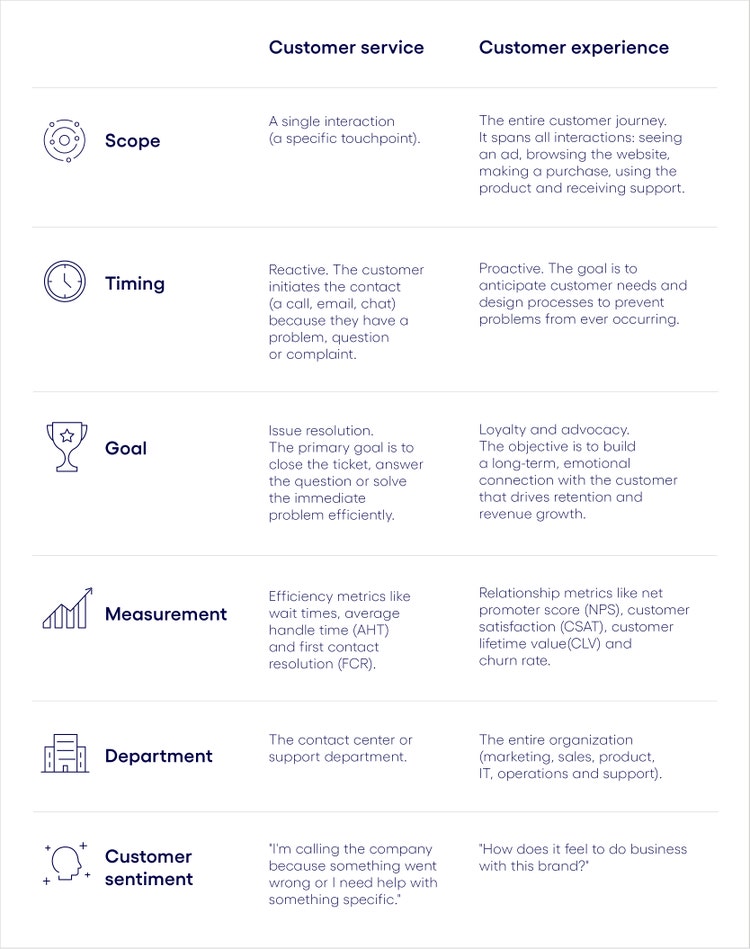
#
<h4><br> How to close the customer service-customer experience gap<br> </h4> <p>The question is how to bridge the gap between the customer service and customer experience mindset. That’s where CX engagement comes in.</p> <p>CX engagement is a strategic effort to fundamentally transform how businesses interact with their customers. Instead of just improving customer service, CX engagement helps businesses move from a scattered approach to one that is proactive, personalized and focused on what customers get out of the engagement. It delivers tangible improvements in customer experience, such as increased retention, growth and efficiency. The goal: sustainable growth in a customer-centric world.</p> <p>CX engagement accomplishes these goals by:</p> <ol> <li><b>Breaking down silos</b>: Unifying departments and data to ensure the experience is consistent across touchpoints.<br> <br> </li> <li><b>Driving proactivity</b>: Using agentic AI and data analytics to anticipate needs, so the customer doesn't have to call for service in the first place.<br> <br> </li> <li><b>Focusing on outcomes</b>: Measuring success not by how fast a call was handled but by the ultimate business outcome—like reduced customer churn or increased lifetime value.</li> </ol> <h4>Key strategies for CX engagement success</h4> <p>To successfully pursue CX engagement and achieve measurable outcomes, organizations must focus on three critical areas:</p> <h5><span style="font-weight: normal;"><span class="text-bold-italic">1.</span> Define the CX strategy and roadmap</span></h5> <p>This involves clearly defining the ideal customer experience and ensuring it aligns with core business goals like customer lifetime value (CLV) and cost reduction.</p> <p>Businesses need to map customer journeys across all touchpoints to pinpoint pain points and opportunities for improvement. For instance, a customer might start by making a purchase from a website and completing payment. But although the transaction doesn’t go through, the customer discovers a charge on their account. They reach out to customer care to inquire what went wrong. The call is deflected to an AI bot that can answer the questions regarding the failed transaction and reissue the order.</p> <p>Because the business has set up the system to collect customer data from all these touchpoints (web, phone and chat), the customer has a seamless, satisfactory experience.</p> <p>The goal is to set clear and measurable goals, directly linking them to C-suite metrics such as net promoter score (NPS), customer satisfaction (CSAT), churn rate and cost to serve.</p> <h5><span style="font-weight: normal;"><span class="text-bold-italic">2.</span> Consider how agentic AI can help</span></h5> <p>Agentic AI is moving CX engagement beyond reactive, rule-based systems into a proactive, intelligent and autonomous delivery model. For instance, when a customer calls their internet provider, the system could quickly identify connectivity issues and proactively run a diagnostic, communicate the turnaround time and follow up for closure.</p> <p>This shift allows for the design of CX platforms that can anticipate customer needs and resolve complex issues end-to-end. The result: a hyper-personalized experience that is continuously optimized for superior customer outcomes and organizational efficiency.</p> <p>However, success hinges on the crucial step of merging, cleansing and harmonizing data to ensure accurate insights. Doing so ensures that customers won’t need to explain their issues repeatedly or that manual interventions and escalations won’t drive up cost per interaction.</p> <h5><span style="font-weight: normal;"><span class="text-bold-italic">3.</span> Calculate direct and indirect cost savings</span></h5> <p>CX engagement yields significant financial benefits through two main avenues:</p> <ul> <li><b>Direct cost savings</b>: These arise from improved operational efficiency within the contact center. For example, when agents can resolve issues faster due to having a holistic view of customer data, it reduces average handling time and response time. They can also handle more problems on first contact, and customers can utilize self-service options more often, increasing deflection.<br> <br> </li> <li><b>Indirect cost savings</b>: These stem from a better overall customer experience. This leads to reduced customer churn, lower customer acquisition costs due to increased referrals, fewer costly service recovery efforts and improved employee retention.</li> </ul> <h4>Driving business objectives with CX engagement</h4> <p>The objective of CX engagement is clear: to enhance customer satisfaction, loyalty and advocacy, which in turn leads to increased revenue, reduced costs and a greater competitive advantage.</p>

<p>Pranoy Banerjee is a dynamic and results-driven contact center strategy consultant, leading complex, global customer service initiatives for high-growth enterprises. He is the go-to expert for organizations seeking to navigate the complexities of digital customer service, turning their contact center from a cost center into a strategic asset and a competitive differentiator.</p>