
Meet your next hire: The Agentic Employee
<p><br>
<span class="small">April 23, 2026</span></p>
<h2 class="h6">Assess your enterprise readiness and design your first human led, agent operated workflow.<p></p>
</h2>
The nature of work is changing faster than most organizational structures can keep up. Hiring plans, org charts and transformation roadmaps built for a world where headcount was the primary lever of capacity are struggling to account for something fundamentally new: AI agents that don’t just answer questions, but complete tasks and actually do work.
Not as assistants or as chatbots. As employees.
Digital labor: From automation to agency
For years, enterprise AI investment followed a familiar pattern: automate the simple stuff— balance checks, ticket routing, data entry—and measure success by containment rates and cost reduction. Those gains were real, but they’ve reached their natural ceiling.
What remains are the judgment-adjacent tasks that consume more than half of a senior professional’s time, according to Asana: status reporting, data reconciliation, content generation and workflow coordination, for example. This is where a new category of digital labor becomes transformative.
At Cognizant, we call it the Agentic Employee.
What is an Agentic Employee?
An Agentic Employee is an AI agent assigned to a specific enterprise role, like project manager, financial analyst, HR business partner or IT service desk agent, with a defined scope of responsibilities, access to relevant systems and the ability to take actions within them. Unlike point-in-time tools, the Agentic Employee operates continuously, within policy guardrails and in deep integration with the systems enterprises already run. It is onboarded, governed and measured like any other team member.
Critically, it operates within a model led by human workers (we call this human led, agent operated). People set direction, make judgment calls and approve decisions when it counts. Agents handle execution.
That framing matters. Cognizant CEO Ravi Kumar S has put it this way: AI is an amplifier of human potential, not a displacement strategy. The goal isn’t to remove people from the equation. It’s to remove the friction that keeps talented people from doing their best work.
Three modes, one workforce
The Agentic Employee model operates across a spectrum of engagement.
Assist: The agent works alongside people, surfacing recommendations and providing real-time decision support. Humans stay in control.
Augment: The agent takes ownership of full task segments, freeing professionals for higher-order work.
Autonomously execute: The agent completes multi-step workflows independently, with human oversight at defined checkpoints.
Most organizations begin with Assist, building governance maturity before progressively expanding agent autonomy. At every step, human oversight remains by design.
What an agentic employee looks like in practice
Consider a project manager who spends most of their week on status reports, risk log updates and resource dashboards. These tasks are important, but they’re not why you hired a project manager. An Agentic Employee handles all these tasks, freeing the project manager to focus on stakeholder relationships, strategic decisions and the judgment calls that require experience and context.
The same pattern applies across functions. A financial analyst whose quarterly reporting cycle currently consumes weeks of manual reconciliation. An HR business partner fielding the same policy questions hundreds of times a month. An IT service desk agent triaging and resolving the 70% of tickets that follow predictable patterns.
In each case, the Agentic Employee doesn't replace the human; it reclaims their time for the work that actually requires them.
The productivity evidence is concrete. In Cognizant’s own operations, AI agents reduced legal contract review from 40 hours to 5, cut IT support tickets by 30% and delivered up to a 70% efficiency gain across sales operations for approximately 5,000 users.
In client environments, a regional healthcare provider cut patient enrollment from up to seven days to minutes, while AI now handles 96% of nurse note reviews—compressing an eight-hour task to roughly 20 minutes. These aren’t pilots. They’re live operations. Across deployments, we’re consistently seeing 60% to 70% automation of manual effort, not by eliminating roles but by restructuring them around what humans do best.
The AI builder advantage
Closing the gap between “AI assistant” and “Agentic Employee” takes more than a technology deployment. It takes an AI builder: a partner who blends people, platforms and business context to build agents that do real work in real enterprise environments. This means mapping high-effort tasks, designing human-agent handoff points, and building the governance architecture that makes agentic AI trustworthy at scale. This is the approach Cognizant has taken, including through a co-developed solution with Google Cloud that combines Cognizant’s transformation methodology with Google’s AI infrastructure.
The AI workforce strategy imperative
For business and HR leaders: offload the repetitive to unlock the full potential of your people. For IT: build once, govern centrally, scale broadly. For the C-suite: organizations that deploy digital employees at scale will compound productivity advantages that are hard to replicate. The common thread is governance and a talent dimension that’s easy to underestimate. The workforce that learns to work alongside agents develops skills that will define the next generation of professional excellence. Investing in agentic AI and investing in people are not competing priorities. Done well, they are the same priority.
Onboarding a digital workforce: The four-step model
Deploying Agentic Employees follows a deliberate methodology designed to maximize impact and minimize disruption. Cognizant's approach structures deployment across four phases:
- Identify roles: Map enterprise functions to define the distinct domains where an Agentic Employee will operate.
- Identify tasks: Isolate the specific tasks within each role that account for 60% to 70% of manual effort. These are the high-frequency, lower-judgment activities that agents are purpose-built to handle.
- Map the human and agentic flow: Define exactly where agents execute and where humans supervise, approve or intervene. This is the critical design step—getting the handoff points right is what makes the model trustworthy.
- Deploy the workforce: Launch the integrated Agentic Employee into live workflows, monitored via the platform's observability layer and refined continuously as performance data accumulates.
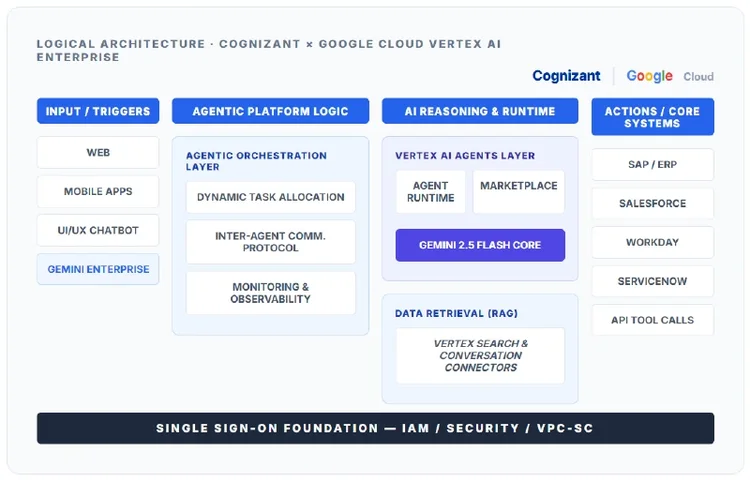
Platform architecture at a glance
The platform is structured across four logical layers—inputs, orchestration, AI reasoning and enterprise system connectors—unified beneath a shared security and identity foundation.
It's time for an agentic employee model
The technology is ready. The use cases are live. The productivity evidence is accumulating. The question now isn’t whether to deploy an Agentic Employee model—it’s how quickly you can build the foundation to do it well, with the right governance, methodology and understanding of where human judgment remains irreplaceable.
Organizations that move with intention today will look back on 2026 as the year their workforce fundamentally changed. Not because they replaced their people. Because they gave them something extraordinary to work alongside.
Connect with the Cognizant and Google Cloud joint team to assess your enterprise readiness and design your first human led, agent operated workflow.